

Buy the Book | Contact Us | Blog | More Books | More Resources | Podcasts | Videos
This website, like the book on which it’s based, is a repost to the snake oil salesmen who’ll tell you what to do to impress inspectors. Don’t be fooled by the title – the subtitle is doing the heavy-lifting. It’s about doing what’s right for your pupils every day, not what’s right for inspectors during their two-day visit. Yes, we unpack the new framework in a way that makes sense to busy school leaders and teachers, and yes we offer loads of practical tools that will help you evidence what you do, but the advice and resources you’ll find on this website are about the long-haul of genuine and sustainable school improvement, not quick fixes. If in doubt, read a sample of the book, you might be pleasantly surprised!
Scroll down for free resources

Buy the book

About the book
How to Ace Ofsted is a practical guide to the inspection process… but it is much more than this.
It also offers tangible tips to ensure a visit by Ofsted is as pain-free as possible – and ends in success. Not by doing anything solely for the purposes of inspection, nor by producing documents only for inspectors’ eyes. But by ensuring that what you do every day is in the best interests of children and communities.
This book is packed with tangible tips and tools – all of which constitute perennial good practice advice about how to make school improvement your routine not your rescue plan.
In short, this is a book not about faking inspection-readiness but about making inspection-readiness your everyday reality.
The author is clear: As educators, we don’t do it for Ofsted; we do it for the children and communities we serve. And if we do what’s in their best interests and act with integrity at all times, then we should have nothing to fear from Ofsted. And this book is about that: doing what’s right for our children and communities and making that work within the inspection process.
It covers: The logistics of inspection under the 2025 framework; how to define disadvantage and embed equity; how to design an ambitious curriculum and deliver inclusive teaching; how to improve attendance and behaviour, and cater for pupils’ personal development and wellbeing; how to protect pupils from harm and educate them about staying safe; and how to support staff and develop their expertise.
This book also explores: ways of creating a positive school culture, underpinned by a shared vision and values; how to communicate and consult with stakeholders, promoting collaboration not competition; how to stay calm and handle conflict; how to lead the school improvement process and manage change; how to lead ethically and develop a strong leadership team; and how to ensure good governance.
It comes complete with downloadable resources including checklists, action plans, and audits.
It is, as one early reviewer has said, “All killer, no filler.”
Keep scrolling
Contents
Introduction
Part One: Inspection-ready when the call comes
Chapter 1: The 2025 framework
Chapter 2: Defining disadvantage
Chapter 3: Inclusion
Chapter 4: Curriculum and teaching
Chapter 5: Achievement
Chapter 6: Attendance and behaviour
Chapter 7: Personal development and wellbeing
Chapter 8: Leadership and governance
Chapter 9: Safeguarding
Part Two: Inspection-ready every day
Chapter 10: Creating the culture
Chapter 11: Vision and values
Chapter 12: Communication and consultation
Chapter 13: Collaboration not competition
Chapter 14: Calm not conflict
Chapter 15: Tweaking to transform
Chapter 16: Principled principals
Chapter 17: Sterling SLTs
Chapter 18: Good governance
Chapter 19: Performance improvement
End matter
Chapter 20: The secret of school improvement
Here you go…
Downloadable resources from the book:
Good practice advice for when the call comes
Analysing the new evaluation areas:
Available now…
5 Personal development and wellbeing
Coming soon…

Preparing for inspection
Inclusion
Curriculum and teaching
Achievement
Attendance and behaviour
Personal development and wellbeing
Leadership and governance
Safeguarding
Alternative provision
Want more help? We deliver training and school improvement services tailored to your school’s needs – get in touch if you want a chat.
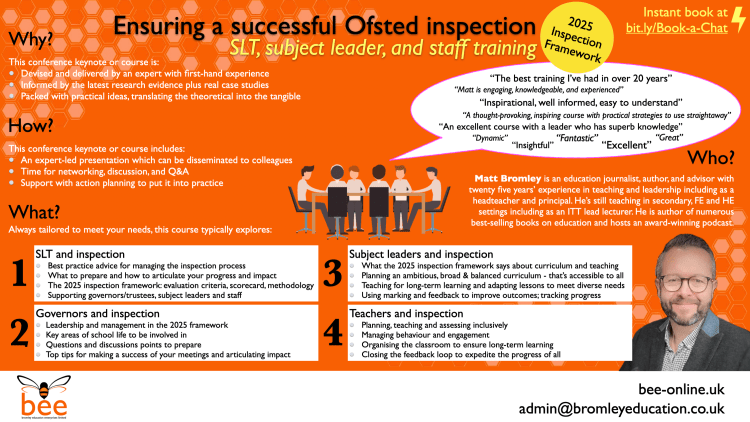
Here’s what colleagues who’ve recently attended Matt’s inspection training have had to say…
“Informative and knowledgeable leader who was both engaging and insightful.”
“Excellent!”
“Very useful – it got us to drill down and reflect on our own practice.”
“Very informative with clear strategic ideas.”
“A very welcome overview of the process.”
“Really informative – it’s made me feel a lot clearer as a new Headteacher of what I need to do to prepare for OFSTED.”
“Very helpful and covered all the main areas.”
“Very thorough and the presenter was engaging.”
“Very informative and thought provoking.”
“Really informative, well-paced, and gave me the information I needed.”
 bee | Bromley Education Enterprises Limited