
About the book | About the authors | Matt’s story | Andy’s story | In the media


Welcome!
This website contains resources to accompany the book, The Working Classroom.
If you haven’t yet picked up a copy of the book, you can do so from…
Why not read the stories that inspired the book…
You can watch Matt and Andy being interviewed about the book…
Contact us
Email us hello@theworkingclassroom.co.uk
Visit Matt’s website at bee-online.uk
Follow Andy on X: @OTeaching
About the book

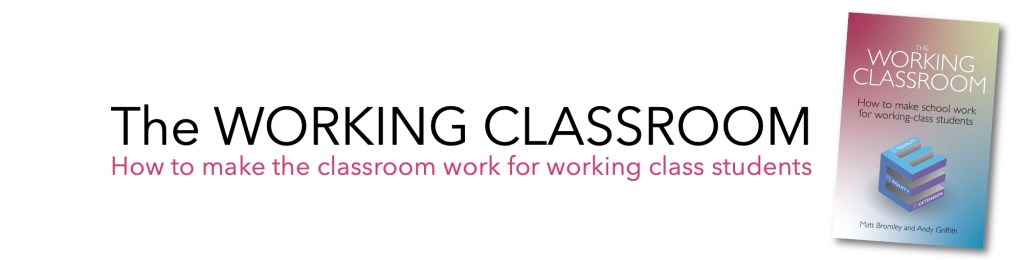
Written by Matt Bromley and Andy Griffith, The Working Classroom: How to make school work for working-class students offers practical strategies and tools to help secondary schools address the needs of working-class students, including by building cultural capital and designing learning that is more engaging to working-class students.
About the authors
Matt Bromley
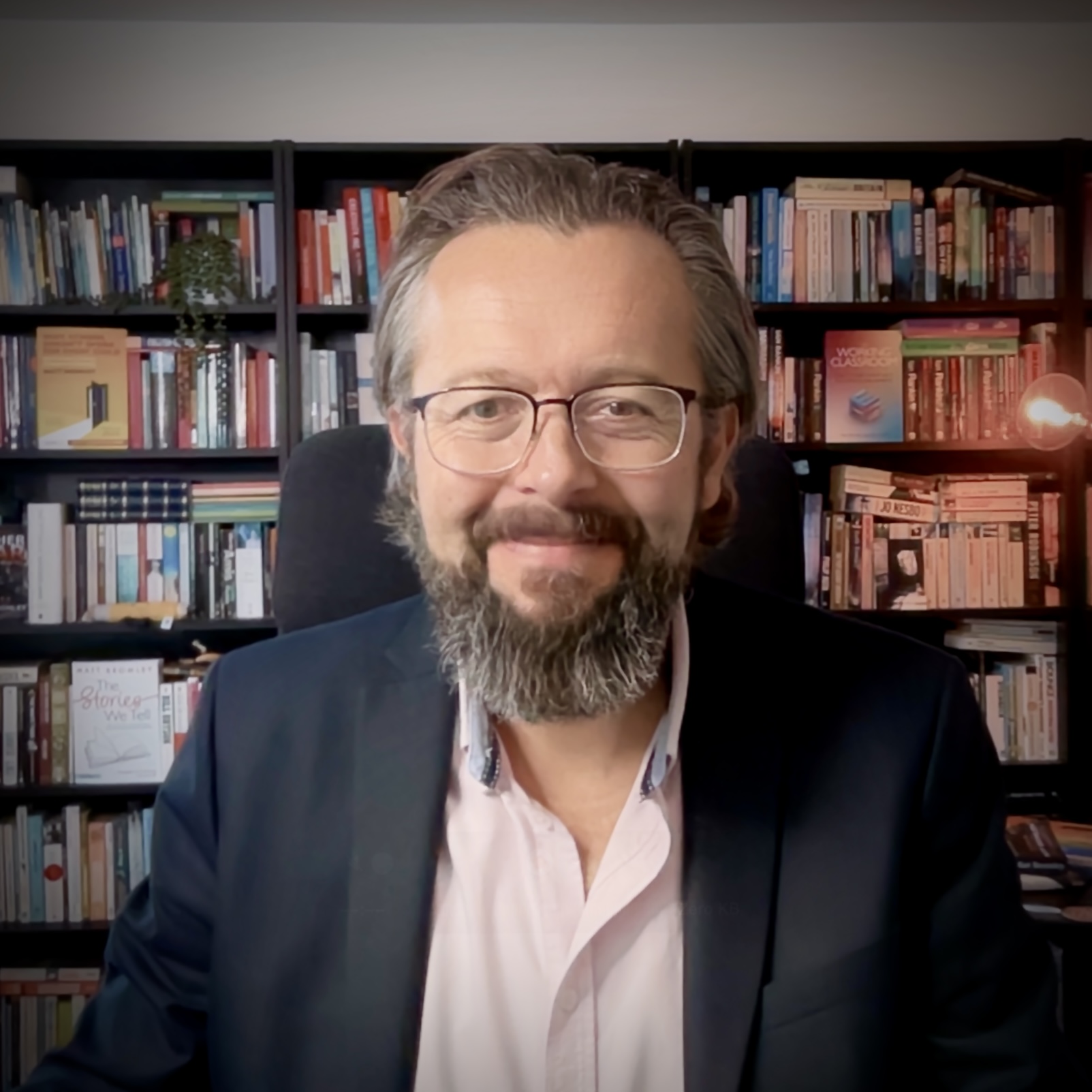
Matt Bromley is CEO of bee and Chair of the Building Equity in Education Campaign. He is an education journalist, author, and advisor with twenty five years’ experience in teaching and leadership including as a secondary school headteacher and academy principal, further education college vice principal, and multi-academy trust director. Matt is a public speaker, trainer, initial teacher training lecturer, and school improvement advisor. He remains a practising teacher, currently working in secondary, FE and HE settings. Matt writes for various education magazines including SecEd and Headteacher Update, and he is a columnist on The Yorkshire Post. He is the author of numerous best-selling books on education and he co-hosts an award-winning podcast.
Andy Griffith

Andy Griffith is the founding director of MALIT Ltd. He has won a national training award for his work in education and has consulted for a number of organisations including the BBC and Comic Relief. Andy’s prime focus is to design training and learning opportunities that challenge people to strive for excellence. Andy’s work has been shortlisted in the Best Learning & Development Initiative – Public/Third Sector category of the 2018 CIPD People Management Awards.
Matt’s story

I was born and brought up in a depressed northern town in the shadow of dark satanic mills and disappointment. My family and I lived in a row of terraced houses which stuck out from the valley side like needles on a hedgehog’s back. And life was just as spiky.
My childhood, although happy, was one of hand-me-downs and making do. And my primary school – in the days before ‘serious weaknesses’ and ‘special measures’ had become the de facto vocabulary of educational failure – was what we used to call ‘shit’.
When I wasn’t pretending to paint while surreptitiously sneaking a peak at the page 3 model on the newsprint laid out to protect the tables, I sat cross-legged on a threadbare carpet while the teacher strummed his guitar and sang 1960s songs. (And yes, dear reader, he closed his eyes when he hit the chorus.)
As a result, when I transferred schools aged 9, I was unable to construct a sentence. It was only thanks to a determined and dedicated Year 5 teacher who inspired a love of reading that I caught up with my peers.
This story, like all good stories, I suppose, was repeated years later when my Year 9 teacher – an inspirational writer and poet who had lived in Peru and taught me how to bet on horses – recognised and nurtured my talent for writing.
This tale was told once more when my A level English literature teacher – a fierce and frightening man, hump-backed like Richard III, but one of extraordinary talent who ignited my love of Shakespeare – set me on a path to university.
You know how the story goes: I was the first in my family to get to university and lucky enough to be awarded a full grant at a time when the state recognised its duty to educate all, not just those born to privilege. But my grant didn’t go far, barely covering course fees and accommodation, so I worked round the clock – stuffing envelopes for a bank and being sworn at on a complaints line – to pay for books and stationery and food and drink. Mainly drink.
On the last day of my first year, I was badly injured playing football and had my right foot set in plaster. I was instructed by A&E to keep my leg elevated and rest for three weeks. Had I followed these instructions, I would be able to walk without pain today, nearly thirty years later. But I had no option: I simply had to work if I was going to afford to return to my studies. Consequently, I walked on crutches to and from the bus stop every day that summer. I took as much overtime as I could get, working seven days a week. And I have lived with the consequences every day since; my foot never healed and it causes constant pain, which is slowly getting worse as arthritis sets in.
Poverty removes agency
You see, poverty forces people to make tough choices. Actually, that isn’t true: poverty removes choice; it denies people agency and opportunity.
Writing in The Guardian in June 2022, the food writer and poverty campaigner, Jack Monroe, powerfully describes the consequences of poverty:
“Poverty is exhausting. It requires time, effort, energy, organisation, impetus, an internal calculator, and steely mental fortitude. And should it not kill you, in the end, from starvation or cold or mental ill health, should you scrabble somehow to the sunlit uplands of ‘just about managing’, I’m sorry to tell you that although your bank balance may be in the black one day, so too will your head.” [1]
Monroe goes on to explain how ‘years of therapy has alleviated some of [the worst effects of living in poverty, such as panic attacks], some of the time, but [their] physical and mental health will probably never make a full recovery’.
Monroe now suffers from ‘complex post-traumatic stress disorder, arthritis exacerbated by living in cold homes, respiratory difficulties from the damp, complex trauma, an array of mental health issues, a hoarding problem, and a slow burning addiction brought to an almost fatal head last year’. However, they argue that their story is by no means unique or exceptional because ‘short-term exposure to and experience of poverty – whether fuel poverty, food poverty, period poverty, or the root cause of all of them, the insufficient resources with which to meet your most fundamental human needs – has long-term and disproportionate effects for years to come’.
Childhood exposure to poverty falls under the umbrella of adverse childhood experiences (ACEs), which, according to Monroe, are ‘on a par with domestic abuse, childhood sexual assault, [the] loss of a parent, parental incarceration, violence and neglect’ and increase the risk of trauma later in life, both mentally and physically.
In fact, exposure to ACEs leads to less favourable health outcomes, a negative impact on general well-being, increased likelihood of risky or criminal behaviours, poor educational and academic outcomes and financial difficulties. We know that children who experience food insecurity, even short term, are more likely to fall ill and need hospital admission and have a slower recovery rate.
Access denied
Poverty led to me making tough choices that I live with even now. But I know I was lucky; as well as state-funded support that enabled me to go to university, I had good teachers and loving, supportive parents who provided me with a safe and happy home. But it could easily have been so different. As I mentioned, I was the first in my family to go to university – and that was not uncommon in the mid-1990s because access to higher education had begun to widen. I was, as I say, lucky.
Danny Dorling, professor of human geography at the University of Sheffield, says the fact the majority of additional places at universities were taken up by children living in the poorer half of British neighbourhoods ‘may well be seen … as the greatest positive social achievement of the 1997–2010 government’ and that it was achieved ‘not at the expense of upper- and middle-class children [but because] the education system as a whole expanded [and] massive increases in funding per child in state secondary schools’.[2]
Dorling says the lessons of the pre-2010 era are clear: ‘Spend more per child and they will gain better GCSE results, they will then go on to attend university in greater numbers.’ There are two other factors: firstly, the introduction of Education Maintenance Allowances (EMAs) ‘which enabled many young people from poorer areas to be able to afford to stay on at school’ and, secondly, government funding of university places which is ‘the ultimate determinant of what young people’s chances are’. [3]
Sadly, these improvements in access to higher education for working-class children have not been sustained. Writing in 2012, Dorling said progress would likely be ‘reversed following the Comprehensive Spending Review of October 2010’. He was right: EMAs were scrapped in 2010 and the spending review cut up to 75% of government funding in higher education. Even before these cuts – made under the auspices of ‘austerity’ – ‘access to good schools, universities and jobs remained far more socially determined by class and place of birth in Britain, than in almost any other affluent nation’. [4]
The fear of being different
When I went to university, for the first time in my life, I found myself living and socialising with people from vastly different social circles. And – despite the fact that my fellow freshers’ higher social status, wealth and expensive education had led them to the same university and that I went on to gain a better degree than many of them – they looked down on and ridiculed my hometown, my accent and my lack of what we might now call ‘cultural capital’. They travelled to lectures in cars bought for them by their parents; I walked or cycled on a second-hand bike I had repaired and repainted. They never had to worry about where their next meal was coming from and never had to say no to a night out or stay in halls while those around them partied, because to go out would have meant being unable to afford the books that were essential reading for their courses.
When I left university, having worked on the student newspaper as a sports and features writer – a post I had to fight hard to get because I didn’t have the right school tie – I pursued my chosen career in journalism on my hometown paper. Or, rather, I tried to. Internships were awarded to those whose father knew the editor or proprietor. Although, through sheer tenacity and – more crucially – offering my services for free, I was able to get freelance gigs, there was no hope of a salaried job without a postgraduate qualification in journalism – a requirement of joining the National Union of Journalists.
With student debts from my undergraduate course and no possibility of working for free forever, I had no choice but to find paid alternative employment. For months, I tried to balance the two: working nine to five for a telecoms company and then walking to the newsroom to work evenings for free. But, eventually, paid work had to take precedence and the prospect of overtime and paying off my debts won the day. And, thus, my dreams of a career in journalism slowly died. Not because I lacked the talent, but because I didn’t have the money and ‘secret knowledge’ needed to get a foot in the door.
Telecoms wasn’t so class driven, thankfully, and I was lucky to get in at the time that mobile phones were becoming mainstream. I quickly proved my worth and climbed the corporate ladder to senior management. The pay was good, as was the lifestyle; I was in my mid-twenties, working hard and playing harder. All seemed right with the world. But it wasn’t. Cue existential crisis …
One day, at the dawn of the millennium, I woke up and realised I needed a greater purpose in life. So, it was a brand-new millennium and a new-brand me – I was going to be a teacher and help build the future. Sadly, my epiphany was short-lived. Soon after starting my self-funded PGCE, my dreams of ‘O Captain! My Captain!’ fell apart at the seams.
It didn’t help that I went from earning a decent salary to paying for the privilege of teaching. I had saved enough money in the years prior to scrape through the course, but it was tough living like a student again. Nor did it help that I was several years older than most of my fellow trainees. But the worst of it was my first school placement, and therefore my first foray into the classroom. To be fair, I was warned. My course tutor told me the university had considered taking the school off its books because it was in special measures and they’d had complaints, but because I was older and had leadership experience, they thought I would be able to cope.
The school had been in special measures for a while by the time I arrived, and staff turnover was high. As a result, many post-16 classes were cancelled and other classes were combined, with students often left to watch television in the canteen. Hence, at the end of my first week, my school-based mentor and head of department (who also quit before the end of my placement), said she thought I was ready to go solo rather than waste my time observing her or team-teaching with more seasoned colleagues. And so I found myself, two weeks into my ‘training’ and after just one week in a school, teaching a full timetable without any help or support.
Student behaviour was ‘challenging’. The canteen was like a scene from Fight Club. Staff cars were routinely vandalised, and the fire alarm sounded fifteen times a day – not because some cheeky young scamp had smashed the glass to get out of class but because some cheeky young arsonist had set fire to the building. You might say my early teaching experience was a baptism of fire.
It didn’t help my mood when winter set in and the nights grew long and dark. Snow fell early and deep that year, meaning weeks of indoor play. All of which made me think of quitting teaching every single day. Pathetic fallacy or just pathetic, I am still not sure.
I remember struggling out of bed at the call of my bedside alarm feeling sick to my stomach, and the lonely commutes home, feeling lost and alone, out of my depth, utterly exhausted. Although I told no one, I deeply regretted my risky change of career and yearned for a return to my cushy corner office and generous expenses account. But I was scared to admit to anyone else that I had got it wrong. And I was still driven by a desire to do what my teachers had done for me: to give disadvantaged students a fair start in life, to reverse society’s ills, to mitigate – albeit in some small way – the consequences of poverty and of living in an unequal, unfair society that privileges the privileged and rewards wealth with wealth.
Against all odds, I persevered and survived to the end of my placement and then to the end of my course. My university tutor wrote a glowing report based not, I suspect, on my teaching ability but on the simple fact that I was not dead. The school even offered me a job. Unsurprisingly, I turned them down.
Having passed my initial teacher training year, I got a job in a school in a deprived area of a northern town, and I stayed there for eight happy years, rising from newly qualified teacher to assistant head teacher. I saw in those ‘sink estate kids’ (not my phrase but one used liberally and insultingly to describe the students I taught) an earlier me reflected back; I saw students set on a path to failure in need of a teacher who could turn disadvantage into advantage. I had found my vocation – and I have never looked back.
I have never considered leaving the profession. Yes, I have changed course – I have moved from teaching to leadership and from leadership to consultancy – but each move I made has been an attempt to do more for disadvantaged children, to increase the size of my classroom and thus the impact of my actions.
This commitment has driven me for over two decades, as a teacher, middle leader, senior leader, head teacher, multi-academy trust director and now school improvement advisor. And this commitment has brought me here to write The Working Classroom. I have authored several other books of which I am proud but, to quote the movies, this time it’s personal.
References
[1] J. Monroe, Poverty Leaves Scars for Life – I’m Still Scared of Strangers at the Door and Bills Through the Letterbox, The Guardian(16 June 2022). Available at: https://www.theguardian.com/commentisfree/2022/jun/16/poverty-scars-life-impact-cost-of-living-crisis-felt-for-years.
[2] D. Dorling, Fair Play: A Daniel Dorling Reader on Social Justice (Bristol: Policy Press), p. 180.
[3] Dorling, Fair Play, p. 180.
[4] Dorling, Fair Play, p. 72.
Andy’s story

I was born in Edmonton, North London, and went to primary school in Tottenham. My real father was a magician: he disappeared when I was 8 years old, and I haven’t seen him since. He took out a second mortgage on our family home and gambled it all away. He was working as an insurance agent for a company called Prudential collecting money door to door, as they did in those days, and gambled that away too. I have a memory of him taking me to his office on the day he was sacked from his job; I guess he was trying to use me as a reason for the firm to keep him on. That tells you something of the man’s character.
What followed for me, my mum and brother were bailiffs, temporary accommodation, a council flat, a spell in hospital for me with pneumonia and pleurisy, and quite a lot of stress. Well, they do say that moving house is stressful.
Some years later, my mum met a guy who eventually became my stepfather. His name was Emerson Griffith, and he was originally from Barbados in the West Indies. He was part of the Windrush generation. When I went to secondary school, I took my stepdad’s surname and, after a few years, began calling him ‘dad’. He had a lot of good qualities and valued education. He initially started as a welder for British Oxygen before becoming a lorry driver for the Post Office (or GPO as it was then known). Outside of work, he was a football official. In the 1980s, he became the first Black linesman in the football league and refereed for many years at semi-professional level.
When I wasn’t playing football, I went to his games and watched from the stands. We became close, and I guess learning about his life really opened my eyes to how racist people could be. All the way through his life, Emerson had some significant mental health issues to contend with and he also had a problem with gambling. What are the odds on that! When he retired from his job at the GPO, he gambled away his lump sum of over £25,000 in the space of about six months and then proceeded to blame the world and his wife, my mum, for his errors. It is a long story, but he ended up kicking my mum out of the house, and a few months later setting fire to it as a protest against a court ruling, consequently invalidating much of the insurance.
Anyway, I would rather talk about my mum. All through my childhood, my mum was a constant source of encouragement and supported every interest I had. Despite the fact there wasn’t much money, she would always bring home magazines such as Look and Learn and World of Wonder, take us to the local library, and on trips to museums and famous London landmarks, always on the bus or train as we didn’t have a car.
My mum, like many working-class children of her generation, had to leave school at 15 before she could take O levels. I have no doubt she would have excelled. As testament, she has got a book at home that was she was awarded for winning the prize as the best historian in Peckham School for Girls. Mum had to get paid work in order to support her family. Her mum, my nanny Alice, was disabled and unable to work. She transferred this love of learning, especially history, to her sons; every qualification I have achieved since, I dedicate to her.
Igniting a spark
Every child needs at least one encourager or ‘sparker’ in their life, someone who opens up future possibilities and helps them to see what might be possible. Later in the book, we will talk about lucky kids, a metaphor borrowed from early years specialist and author Penny Tasoni.[1] I want to make it clear that, like Matt, I consider myself lucky to have had a mum who read to me, took me places, talked with me and set boundaries for me. But what about kids who don’t have someone like that in their lives? Should schools deliberately try to make up for that? My view is, yes, they should.
I went on to a comprehensive secondary school in London where I was pretty well-behaved bar the odd fight here and there. I might have been kicked out of a modern day ‘no excuses’ school, but I was regarded as an asset: captain of the football team, top sets, high grades and so on, and one of the few students who went on to university.
My school was a true comprehensive: a mix of people from all social backgrounds, religions and races. I had some working-class and some middle-class friends – some whose parents were reasonably wealthy. They are still my friends to this day. We have helped each other over the years, and one friend in particular has helped me through some difficult times. I would be worse off if I had closed myself off from having friends from middle-class backgrounds.
During these years, I also represented my borough, Haringey, at football. Like school, I had to travel to training and matches by bus. This was a gift because I enjoyed travelling and used that time to read. One experience playing for Haringey has really stuck with me. The team went to Holland on a football tour, and I was the only one who didn’t go as my family couldn’t afford it. All the other lads came back with new kit and shared experiences; I have never felt so left out.
First encounters with classism
It was at Manchester University that I first experienced what I have come to understand as ‘classism’ – some people treating me as inferior because I was from a working-class household. It is easy to internalise that feeling of being ‘less than’ because your family cannot pay for branded clothes. I always got my jeans and school trousers from Edmonton market. Even at university, I was still wearing hand-me-down clothes from my cousin – even underwear, and she wasn’t even my size! That feeling of being poor never leaves you. Even now, when I have the money to make a major purchase, I still go into a cold sweat of thinking I cannot afford this.
It was at Manchester where I first met people from private school. They seemed to be much more self-confident. It took me over a year to realise that confidence doesn’t equate to intelligence. One tutorial stands out for me still. A guy started talking and a bulb lit up in my head. I realised that he wasn’t bothered if he was right or wrong – in fact, he was an idiot. Me? I was scared of saying anything that might be incorrect.
Like most working-class students, I had to work while I was at university. Luckily for me, being from London, I could always pick up jobs during the holidays, such as working as a bin man or road-sweeper (I was very good, by the way, and if I had stuck at it, I could have won the prestigious Golden Broom). My jobs didn’t affect my studies, but these days working-class students face a very different labour market. They have to work evenings and weekends in bars or supermarkets, which inevitably reduces their study time.
After university, the advantage of coming from a wealthy family really kicks it. Working-class graduates simply don’t have the connections and networks to apply for certain career pathways that are dominated by the more affluent. Some do break through into the professions as barristers, doctors and so on, but it is a far tougher path. This lost talent is a massive waste to both the economy and to the well-being of those who could have had a different life path.
When I left university, I went into teaching. From 1989, I taught for twelve years in three different state sector secondary schools. I taught subjects such as economics and business studies to Key Stage 4 and 5 classes; lots of exams and lots of marking. I enjoyed teaching, but I didn’t enjoy the restrictive exam syllabuses. It felt like I was training students to pass exams, not understand the subject. Still, I proved to be pretty good at this. However, with each passing year, my enjoyment of being a teacher ‘in the system’ went down and down.
In the last few years of my full-time teaching career, I got the break that I was looking for – to work with students on a curriculum of my own design. My school decided to take the opportunity to ‘disapply’ some students from the national curriculum – that is, to remove certain Year 10 and Year 11 students from lessons such as languages and get them doing something else. These were generally statemented students; many had poor motivation and poor behaviour.
I offered to create a programme for them called Lifeskills, where I taught them for two hours a week over two years. These students learned how to analyse a film, how to revise, how to talk about yourself confidently, how to recognise your own strengths, how to cook at least five different dishes and how to present to an audience. Pedagogically, there wasn’t much writing, plenty of discussion and lots of one-to-one work (the students created career portfolios and scrapbooks); nearly all the students gained in terms of confidence, and they gathered a few certificates too.
In 2001, I left full-time teaching and became self-employed. This was during the New Labour years when it felt like there was more money in education. The experience of creating the Lifeskillscourse was something I wanted more of. Initially, I started training teachers in areas such as careers education and citizenship (I was on the Qualifications and Curriculum Authority (QCA) writing team for citizenship). I created numerous different training courses, and eventually ended up creating a course that thousands of teachers attended called Outstanding Teaching. Its sister course, Embedding Outstanding Teaching, aimed at school leaders, was also very popular. Both have subsequently been turned into modular school programmes involving the video analysis of teachers and strategies for leaders to get the best out of staff.
Being on the training circuit has been an interesting experience. There are lots of talented people out there, but it is surprising that some of those most respected in education are actually snobs. Some have real disdain for working-class people and working-class places. You will have to buy me a pint or two for me to reveal more.
I am now in the autumn of my career. My shampoo is called Back and Shoulders, and it is taking me longer and longer to wash my face every morning. I am now working in places like Kirkby in Merseyside, Bradford in Yorkshire, Newham in London and Fleetwood in Lancashire. I seriously love my working life. I work with great colleagues who are motivated by social justice every day. I decided a few years ago to only work in certain places and only with certain people. I have made a commitment to these communities. In each case, I am just an extra resource, a friend of the school. The core work is done by the leaders, teachers and support staff, but I hope my training and coaching with adults and young people adds something too.
There are some great individuals working in and across schools. They are motivated by fairness, justice and compassion. They are continually trying to close gaps and take daily action to support disadvantaged families. To be around them is inspiring – and you won’t get that from most other career paths.
If you are at all motivated by issues such as fairness and justice, I hope you get something from this book. I am sure you are already helping many people in your career, but my hope is that this book will influence you to help even more. Maybe you are a bit worn down by the system or the school you are in? In that case, I hope it will reinvigorate you for a few more years.
Although Matt and I were both touched by poverty in our early lives, we have written The Working Classroom to inspire everyone involved in education and from every social background. Indeed, for us, it is even more impressive when education professionals from middle-class backgrounds involve themselves in this work. In many ways, they ‘get it’ much more than some working-class people who have, by their own reckoning, progressed into being middle class and consider this was purely through their own merits.
References
[1] P. Tassoni, Reducing Educational Disadvantage: A Strategic Approach in the Early Years (London: Bloomsbury, 2016).
In the media

The book was reviewed favourably by The Times (£)
…and was critiqued – less favourably – in an opinion piece in the same newspaper (£)
Matt and Andy’s guest column on Blinks
Matt writing for HWRK magazine
Matt writing for Headteacher Update magazine
Andy interviewed by Mary Myatt for Myatt&Co: Click here to view via Zoom
 bee | Bromley Education Enterprises Limited