
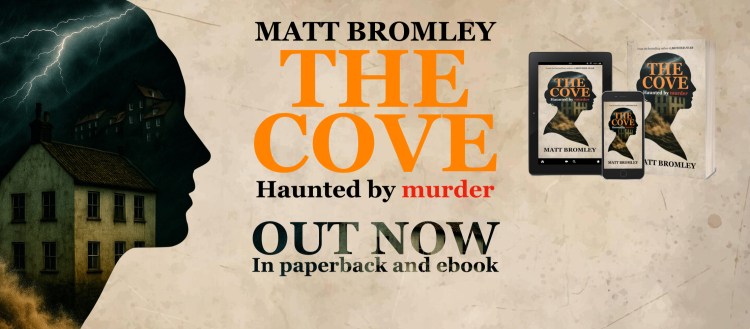
Available in: Paperback | Kindle | Apple Books
The blurb
From the author of Mother Fear comes The Cove: part ghost story, part murder mystery…
Podcaster Sam Spectre agrees to stay the night at The Seacove Inn to investigate claims it’s the most haunted pub in England. But what starts as a ghost-hunt soon becomes a murder mystery when someone’s found dead in the cellar. With the inn sandbagged and cut off by a storm, no one can get in or out… which means the murderer is still there.
Two hundred years earlier, newly orphaned Beth Brodie arrives at the Inn to stay with her Uncle Bert, a shadowy figure who controls the local smuggling trade. Corrupted by contraband, he’ll stop at nothing to protect himself.
With chapters alternating between 1825 and 2025, the events of the past send ripples across time, forming a tidal wave that turns into a tempest as we pivot from an MR James ghost story to an Agatha Christie locked-room mystery in this edge-of-your-seat thriller from the bestselling author of Mother Fear.

Free sample
© Matt Bromley 2026
Chapter One
Now
The village of Seacove clings to the Yorkshire coast like a limpet to rock and much like a limpet its grip is tested by both time and tide.
From the clifftops, it seems impossible that such a place exists. It looks like scree not a settlement; rocks that slipped down the hill and in storms continue to slide towards the sea.
The streets – narrow, twisting alleys where two people can’t pass without brushing shoulders – are like tendrils, the thread-like twines of an insidious weed, or the unruly ringlets of a siren’s hair flowing underwater.
Small sandstone cottages lean close as if conspiring, their walls thick and stoic, their red pan-tile roofs layered like the scales of a fish, and their windows small and irregular, set at curious angles to catch the sun or glimpse the sea.
Stairways hewn into the limestone descend sharply, their steps uneven and worn smooth.
The streets, the stone cottages, and the stairways, all tumble down the hillside towards a natural harbour that curves protectively around a patch of sand and cobble.
Nothing is straight, nothing is simple; and nothing is as it seems.
Because the village is as complex below ground as it is above: cellars are dug into the bedrock and connecting tunnels link house to house and land to sea.
Seacove is not built on the land but rather carved into it; it is a place where geography dictates architecture, and where struggle, secrecy, and – above all – the sea, have shaped every wall and walkway, much as they’ve shaped the lives – and deaths – of the villagers.
Today, Seacove is – ostensibly at least – a quaint holiday destination. But beneath its olde worlde charm lies a dark legacy: Seacove was once a haven for smugglers, where salt-stung wind and secrecy went hand in hand.
During the late eighteenth and early nineteenth centuries, when customs duties soared and the Crown’s reach extended only as far as it could see, the people of Seacove turned to the water for more than fish. Brandy from France, tobacco from the colonies, silk from the Orient — contraband flowed into the town as often and as inevitable as the tide. While the Royal Navy stalked the coastline and revenue men clambered across the clifftops, Seacove thrived beneath their noses, veiled by mist and misdirection.
It was rumoured that one could pass a keg of Dutch gin from the harbour to the moor along a honeycomb of hidden tunnels without it ever seeing daylight. Local folklore tells of clogs muffled with rags, signals sent with candlelight, and dwellings doubling as customs-proof caches. From blacksmiths to bakers, fishermen to farmers, the entire community is said to have played a part — united by silence and survival.
The smuggling trade peaked in the latter half of the eighteenth century when war with France made imported luxuries rarer and profits richer. It was not a crime in the modern sense, but rather a defiance born of necessity — a quiet rebellion, a cold civil war.
In time, stricter enforcement brought the golden age of smuggling to a slow end, though the village’s twisting tunnels and sunken cellars are said to remember everything.
Today, most holidaymakers stroll Seacove’s cobbled streets unaware of the casks that once rolled beneath their feet. But the sea still whispers its secrets and if you listen carefully, it’s said you can still hear the echoes of footsteps, the creak of a smuggler’s cart, and the clink of forbidden glass in the dark.
At high tide, the sea reaches hungrily towards the village, crashing over the seawall to splash cottages and soak cobbles. Visitors play dare with the tide but invariably lose that battle of wills, laughing as they retreat to safety, soaked to the skin. At low tide, the sea withdraws to reveal a glistening expanse of rock pools, strips of seaweed, and layers of fossil-laden stone — remnants of ancient worlds embedded in the very bones of the place. Children hunt for crabs among the crevices, while walkers pause to breathe in the tang of salt and seaweed, that bracing North Sea air that tastes of history and myth.
There is only one narrow road leading steeply from the clifftop to the harbour and, as he began his descent, Jon Geist held his breath and prayed no one was coming the other way. The van’s three passengers – Sam Spectre, Paul DeMont, and Georgie Wraith – peered out through the steamed-up windows at the tangle of stone cottages that pressed tight against the hillside, as though clinging on by their fingernails to avoid being swept into the North Sea.
At the bottom of the village, where land gave grudging way to sea, stood The Seacove Inn, a pub and guest house with a troubled past. Its eastern façade was built into the seawall and so it appeared to reach out of the sea, a hand searching for land, a sailor hoping for rescue. It was less a building, more a shipwreck washed ashore and left to rot. Barnacled stone walls and blackened timbers bore scars of centuries of storm-battering, and the pub’s seaward flank still took the full fury of the tide today.
In fact, the waves lashed at it now — angry, rising, half-mad — as though trying to reclaim what had once belonged to them.
A storm was coming.
The van came to a stop on the cobbled street beside the harbour wall. Jon climbed down from the driver’s seat, aching at every joint, and rolling his neck until it clicked. He looked up at the pub. The Seacove Inn stood like a watchtower at the convergence of land, sea, and story, a place of ends and beginnings.
Sam was next to step down from the van into the biting wind. She, too, paused to take in her surroundings before retreating further from the vehicle. Above the warped doorframe, she noticed a wooden sign which creaked as it swung back and forth: The Seacove Inn – Est. 1725. And beside the door stood another sign: The most haunted pub in England.
It was this claim that had brought Sam and her team to Seacove. Not the sea, nor the surf; but supposed spirits and spooks.
Paul and Georgie emerged from the back of the van now, stretching their legs and filling their lungs with sea air, relieved to finally be free of the suffocating stench of diesel. They stood alongside Sam and Jon.
“Is this it then?” Paul asked. “Home for the next two days?”
Without reply, Sam began her ascent up the stone steps to the inn’s front door.
“We can’t leave the van here. It’ll get clamped,” Georgie said, giving Jon the side-eye.
“Then let’s say hello, unpack the van, and Jon can take it back up the hill.” Sam disappeared into the pub before Jon could object.
Inside, the inn exuded the quiet charm of a bygone era. Low-beamed ceilings and flickering hearths spoke of smugglers and seafarers, of storms weathered and secrets whispered over pints of dark ale. Mullioned windows framed the ever-changing seascape — grey and brooding one moment, sun-dappled and inviting the next — while the rhythmic hush of the tide below seemed to echo through every stone and timber.
Though modest in stature, Sam thought The Seacove Inn still held a certain romance — a place suspended between past and present, solitude and sociability.
Sam had read that The Seacove Inn had been a central cog in the smuggling machine, its innkeeper the master strategist. Some claimed it still had sealed cellars never found by the Excise. Others swore those caught betraying the operation were not simply warned off; they were walled in.
Chapter Two
Then
It was dark in the coach, and the torch had offered but a small halo of sickly yellow light. The draught through the crack in the roof had sent the flame flickering erratically, threatening the dry leather walls, and so Elizabeth had extinguished it, favouring darkness to danger.
Huddled in a corner, swaying with the motion of the coach, she now felt a growing unease. Solitude had never seemed so hostile. The carriage, which earlier had rocked gently like a cradle, now groaned and creaked with menace. The wind clawed at the roof, and the rain – unhindered now that the shelter of the hills had abandoned them – lashed at the windows with increasing fury.
On either side of the track stretched endless moorland, bleak and barren. No trees, no cottages, no hint of a proper road – just mile upon mile of black wilderness rolling away like a desolate sea to an invisible horizon. No one could live in such a place and remain unchanged, Elizabeth thought. Children born here would surely be warped by the wind, twisted like the blackened shrubs that bowed beneath its force. Their thoughts would be gnarled, too; shaped by heather and cotton-grass – something elemental and dark. Those who walked across this land would indubitably carry some trace of it in their blood.
The track stretched on through this silent, godless country. Not a single light flickered across the landscape, not even a shepherd’s lamp to break the dusk. Perhaps there was nothing and no one – no hut, no dwelling, no human life – in all the long twenty-five miles that lay between civilisation and their final destination.
Time and distance blurred. It could have been midnight, and the miles could have been a hundred, for all Elizabeth knew. Clinging to the familiarity of the coach, she found some small comfort in the worn leather seats and the leaking roof, the patter of rain ticking like a clock. At least she wasn’t entirely alone; the driver was within shouting distance.
Suddenly, the horses broke into a gallop, urged forward by the coachman’s urgent cries, his voice instantly torn from the air by the wind. Elizabeth lifted the sash to peer outside. A blast of rain and wind hit like a wall. Blinking the water from her eyes, she saw rough moorland looming close on either side, black as ink in the storm. But up ahead was the clifftop, the ends of the earth where land gave way to water. Reaching the edge of the moor now, the coach crested a hill at breakneck speed and began its deep descent towards the sea.
Elizabeth glimpsed, clinging to the steep sides of the ravine, an untidy tangle of red-roofed stone buildings as they emerged, one by one, from their cloak of mist.
The tall wooden wheels of the carriage rattled in protest as the coach bounced over wet cobbles, narrowly skimming the buildings that seemed to close in on either side, whispering neighbour to neighbour, attempting to stall the stranger’s progress, if not to block her entry entirely.
Elizabeth could hear the sea now, wild waves roaring above the sound of horse’s hooves and the clatter of the coach. And still they descended deeper, the moorland now high above them and distant. The cottages, which disappeared back into the mist and gloom as quickly as they had appeared, each looked deserted. Not a single candle flickered in a window, not a single chimney breathed smoke from its hearth. Was this a ghost town, Elizabeth wondered; a medieval settlement long ago abandoned, left derelict for proving too inhospitable.
Elizabeth heard the driver holler as the coach came to an abrupt halt. The horses stalled, steaming in the rain, sweat and mist rising from their flanks. The coachman dismounted, pulling Elizabeth’s wooden trunk down with him. He looked toward the house nervously.
Elizabeth tightened her cloak, braced herself, and climbed down from the coach.
“Here you are,” the coachman said. “Knock hard – they’ll let you in. I’ve got to push on, or I won’t reach town again tonight.”
And before she knew it, the driver was back in his seat, reins gathered, urging his horses forward again. The coach rattled off into the darkness and was gone, swallowed by the storm.
Elizabeth stood, her truck at her feet, alone. She looked at the building in front of her. The waves lashed at its eastern flank. It should have been a beacon, a lighthouse offering safety and sanctuary to sailors and shipwrecks. But it felt dangerous and threatening, a place of peril not safety, of menace not sanctuary.
Elizabeth lurched at the rattle of bolts being drawn inside the building. The residents must have been awoken by the clatter of horses and the thud of Elizabeth’s trunk being thrown to the floor.
A door flung open. A figure emerged, lantern swinging, casting wide arcs of yellow light.
“Who is it?” came the voice. “What do you want here?”
Elizabeth stepped forward, squinting into the lamplight. The lantern swung close, momentarily blinding her. Then, with a sudden laugh, the man grabbed her arm and pulled her roughly under the shelter of the porch.
He stood there in the gloom, blocking the narrow hallway – grotesquely proportioned. Nearing seven feet tall, with a frame that made the ceiling seem too low, his presence was not so much that of a man as of something less civilised, dragged forward from the dark centuries. A ridge of black brow shadowed his eyes, and his skin, dark and coarse, looked as though it had been tanned by wind and salt and liquor in equal measure.
Strands of dank black hair hung like seaweed over his forehead and ears, and he peered out through the threads with a peculiar glint. His shoulders were a shipwright’s dream – built for bearing timber or breaking a man in two – and his arms dangled long enough that Elizabeth expected to hear the clinking of chains.
But there was more than brute force in him. Behind the simian stoop and the shocking size, there was a face set in contradiction. His gnarled nose met a sagging mouth that had once been handsome, and from beneath the collapsed structure of his cheeks burned two eyes – deep-set and melancholy – that were nevertheless striking. When he grinned, the illusion was complete: a gleaming, yellow-toothed smile, lupine in its suddenness. His grin was not the grin of a man; rather, it was a flash of hunger, something carnivorous, more suited to a pack animal scenting fresh blood.
“You’ll be Elizabeth, then?” he said. “I’m Bert. Your uncle, I suppose.” He laughed again and lifted Elizabeth’s trunk onto his shoulders as if it were as light as air. Elizabeth followed him into the passage without a word.
Bert set his lantern on a small wooden table. And there, in the flickering glow, a woman stepped forward from the shadows.
“Elizabeth, my dear. You came. I didn’t think you would.”
Elizabeth stared at her, uncertainly. Could this woman be her aunt Margaret? If so, the years had been more than unkind; they’d ravaged her. Elizabeth remembered her, her mother’s younger sister, as a rare beauty, a turner of heads.
As if answering the unspoken question, the woman took another step forwards and held Elizabeth’s hands in her own. Elizabeth was shocked at the coldness of her touch and at the texture of her skin, no longer as fine as silk, but rather dry and crinkled like moth-eaten lace. And her hair, once golden, was now pure white. “Do you not remember me, child? I’m your aunt. Margaret. But folk call me Peg.”
Chapter Three
Now
“I’m Jon, sound engineer. That’s Paul, cameraman –”
“–operator. We say camera operator these days, Jon.”
“And that’s Georgie – the woke one –”
“Most people refer to me as the producer. Nice to meet you, Mr Squire.”
“And completing the line-up, our ‘talent’ -” Jon made air quotes, “- this is -”
“No, no, let me guess: Jon, Paul, Georgie… you must be Ringo, right?”
“Sam. Actually.” Sam held out her hand which Bill took reluctantly, the look on his face suggesting he’d have preferred something more intimate. “Nice to meet you. So, you’re the landlord?”
Bill stood back and surveyed the bar proudly. “I am indeed the king of this particular castle, darling.”
Behind Bill, Paul winced at the landlord’s casual sexism; Sam, though, affected nonchalance, keen to break bread with their host. She knew The Seacove Inn spelled success or failure for her career; the stakes were high.
“I told her she should’ve called herself ‘Ringo’”, Jon said. “Then we could’ve been the ‘Confab Four!’”
Sam rolled her eyes. “Ringo is not a girl’s name. I’m not even sure it’s a boy’s name, is it? Wasn’t he called ‘Richard’?”
“Yeah. Richard Starkey. But that’s not the point. The Confab Four. Come on, admit it, it’s good. Because that’s what we do: confab. Well, you do anyway. Talk, converse, discuss…”
“Swallowed a dictionary, Jon?” Paul teased as he unpacked a metal flight case in the background.
“Think you mean thesaurus, Paul,” Sam said with a wink. “And I got it the first time, thanks Jon. I don’t need patronising. I may be a Gen Z-er, but I’m not ignorant. Besides, I’m not calling myself ‘Ringo’ in service of a cheap pun.”
“Says Miss ‘Spectre’!” Jon said, air quotes back out his back pocket.
“That’s a stage name. There was already a Samantha Wilson in Equity. Besides, never heard of ‘nominative determinism’?”
Jon rolled his eyes, which Sam felt he did so often these days they resembled a fruit machine.
“Then why not use it in the title? ‘Spirits with Spectre,’ that’s what I’d have called it. Not ‘Haunted Hotels’. That’s boring.”
“It wasn’t my decision. It’s what Channel Five wanted. Something to do with SEO, they said.”
“The calculators?” Bill looked confused.
“That’s Casio. SEO. Internet searches, something like that.”
“I still think it’s dull. ‘Haunted Hops’ would’ve been better. Or ‘Ale and Apparitions’.”
“Paranormal Pubs,” Bill offered, enthusiastically.
“Now we’re talking, Bill. What do those overpaid execs at Channel bloody Five know, eh? Bunch of snowflakes, I bet. The PC-brigade.”
“And yet,” Sam countered, “I seem to recall you were the most enthusiastic of us when the channel came calling. What was it you said? ‘At last, a proper broadcaster. Back where I belong’.”
Jon’s smile faded. “Aye, well. Snowflakes or not, they’re better than bloody YouTube, that’s for sure. The sound quality’s shocking. It was a waste of my many years of experience. It’s a craft, a fine art, sound recording. Especially on location. When you do your nodding dog–”
“–talking head–”
“–out there,” Jon jabbed a finger in the direction of a window, “I’ll need a windshield and a blimp. And in here – what with all the reverberation because of the wooden floors and whatnot – I’ll need a dead cat.”
“A dead…?”
“A fuzzy cover for the boom, Bill,” Jon explained. Sam noted the marked difference in the tone Jon used with men like Bill and wondered, not for the first time, if he might be a misogynist, resentful at being accountable to not one but two women. Much younger women, at that.
“The point is,” Sam said irritably, “we must make concessions to our new paymasters if we’re to keep them happy and showcase your, ahem, many years of experience in the medium to which they truly belong. So, unless you want to go back to YouTube and Spotify, I’d suggest you accept the show’s called ‘Haunted Hotels’ and drop all the snowflake comments. You sound like a Poundland Farage.”
Jon gave Bill the side-eye. “Yes, boss. Whatever you say, boss.” He snapped his heels together and gave a three-fingered salute. Sam volleyed with a two-finger salute of her own.
“Mr Squire.”
The sound of Georgie’s voice from the doorway made everyone jolt, despite its timidity. Bill turned to face her.
“It’s Bill, love. Mr Squire was my dad, darling.”
Paul flinched again. Two for the price of one sexism.
“Bill,” Georgie corrected herself, as she retrieved some documents from her bag, the act seemingly giving her voice strength. “Do you mind if I talk you through some paperwork before we go any further? Just a few disclaimers, waivers, risk assessments… Permission to film etcetera.”
Jon mimed yawning. Bill laughed.
“Oh, I’m sure all’s in order, petal.”
“Petal.” As Bill spun round to face him, Paul realised he’d said the word out loud not, as he’d intended, in his head.
“Say something, son?” Bill asked.
Paul busied himself unpacking another flight case, affecting obliviousness. “Hmm? Oh, sorry. Just talking to myself. Annoying habit. Checking I’ve got everything. Thinking about frame rates, shutter speeds, white balance, that kind of thing.”
Bill narrowed his eyes. “Right, lad.” He turned back to face Georgie. “Just give me your papers and tell me where to sign, flower.”
“Do you believe, Bill?” Sam asked.
“What’s that, doll?” Bill looked up from the sheaf of papers Georgie was holding out for him.
“Do you believe in ghosts?”
Bill thought for a moment, the slither of a smile creasing his red, wind-beaten face. “I believe in business, love. And they’re good for business. Ghosts. So, on that basis, yes, yes, I do believe.”
“That doesn’t really answer my question, though.”
Bill’s smile widened now but he said nothing.
“Did you know the place was haunted when you bought it?”
“Bought it?” Bill spluttered. “Nah, I didn’t buy it, love; lived here my whole life, I have. I inherited it from my mum when she passed.”
“How long’s your family run this pub then?” Sam asked.
“Long enough,” Bill said enigmatically.
“I’ll have to ask you again on camera, by the way. If you believe in ghosts. We had this thing on the podcast – and Channel Five like it – where we ask if you’re a ‘see-er’ or a ‘cynic’. Then we hear from both sides, like a trial. What evidence do we have that the ghost is real and what’s the counterevidence, what rational explanation could there be?” Sam paused for a moment, then added, “So, which are you? A see-er or a cynic?”
Bill contemplated the question for a moment, caught – as he often was – between the truth and a joke, sincerity and a cheap laugh. The sarcastic smile that twitched the corners of his mouth betrayed on which side of that divide he would land.
“Well, the sign outside’s a bit of a giveaway, love.”
Sam took the bait. “The most haunted pub in England?”
“That’s the one, sweetheart.”
“Did you put that there?”
“That I did, love; that I did.”
“But is it true? To your mind? Is it just some marketing ploy to bring in more punters or have you – or someone you know – actually seen a ghost with your own eyes?”
Bill was about to speak when he was interrupted by an apparition behind the bar.
“Alright, Bill.”
Bill nodded at the young man who had just appeared and who now stood with his arms resting across the top of the beer pumps.
“This is Jack. Jack Porter. Helps out behind the bar. Helps himself behind the bar, more like.”
“Ignore Bill,” Jack said, addressing the crowd, clearly used to commanding an audience. “He’s not quite the unreconstructed ape he pretends to be.”
“Fuck off,” Bill replied. “Or I’ll un-reconstruct your bloody ape, lad.”
“So, you going to make us famous?” Jack asked, eyes flitting from guest to guest.
Jon was the first to respond: “Infamous, maybe.”
“Jack doesn’t need help there,” Bill muttered to himself. Jack shot him a look. “Bring back Ethan, all is forgiven.”
“Ethan?” Sam asked.
“Jack’s predecessor.”
“Fell down the cellar stairs, had to go back home to Hull,” Jack explained. “Probably tried to end it all rather than face another day working for Bill.”
“Then why recommend you if I’m so terrible? Thought you and Ethan were old school buddies?” Bill said.
“Aye, well…”
“Have you seen any ghosts, Jack?” Sam said quickly, keen to avoid things escalating between Bill and Jack. She took a couple of steps towards the bar, careful to step over the loose wires and film equipment that both Jon and Paul had unpacked and laid out on the carpet for assembly.
“Sure. Old Peg lends a hand some nights when we’re busy. Which is more than can be said of Bill here.”
Bill grunted at Jack.
“Old Peg?” Sam asked. “She’s the Grey Lady, right?”
“Grey’s being kind. White, I’d say.”
“It’s just a term for that archetype. A Grey Lady is a tragic female spirit. Very common in the literature. Often, she’s a woman who died of a broken heart or was betrayed by her lover. A jilted bride, a wronged woman, a murdered wife. Grey Ladies are said to drift silently through corridors, often appearing near staircases, windows, or in mirrors. Legend has it, they’re only seen by those about to die.”
“Jesus. Good job I’m pulling your leg then, eh?” Jack said as he removed his arms from atop the pumps, grabbed a bar towel, and retreated a few steps to open the dishwasher. As he did so, a cloud of steam rose above him. When the steam had evaporated, so too had Jack.
As the vapour had risen from the dishwasher, Georgie, who had been laying out documents on the bar for Bill to sign, could’ve sworn she’d seen a face in the mirror behind the optics. A woman’s face. Old. White-haired. And smeared in blood.
Chapter Four
Then
Peg held Elizabeth’s hands with fervour, stroking them. Then, without warning, she collapsed against Elizabeth’s shoulder and sobbed – great, heaving gasps, as though grief were a creature living in her chest, rising now for the first time in years.
Bert growled.
“Enough now, woman. What kind of welcome do you call this? Squalling like a fishwife. The girl needs food, not a wet shoulder. Take her through, will you? Feed her something.”
With terrifying ease, he lifted Elizabeth’s trunk. “I’ll take this up to your room.”
Peg made a visible effort to collect herself, smoothing her thinning hair with quivering hands, mustering a frail smile.
“You mustn’t mind your uncle,” she said, leading Elizabeth down a corridor that smelled faintly of mildew. The kitchen was lit by three tallow candles and a smouldering turf fire. Smoke curled into the ceiling and hung in the air.
“Your uncle has… his ways,” Peg said. “He must be humoured. He’s a good husband to me and the people here respect him.” The words were too fluent, too polished. Like lines from a play too often rehearsed.
Elizabeth murmured some polite response, but her aunt’s eyes would not meet hers, perhaps fearing a knowing glance would betray the theatre of the moment.
Before long, Bert had returned. His entrance silenced the room. He stood in the doorway, watching.
“Henhouse already in full chorus, eh?” he muttered. “Gobble, gobble, gobble.”
He yanked a chair from beneath the table and threw himself into it, grabbing bread and dripping and shoving it into his mouth.
Behind her, Peg dropped a pan with a frightened cry. Elizabeth moved to help, but Bert stopped her with a bark. “One fool’s enough.” He licked his fingers and leaned back. “What’ll you drink? We’re not short of bottles.”
She asked for tea, and he scoffed, but ordered Peg to give it. “You’ll need brandy soon enough, like the rest of us. It’s no place for tea, The Cove. You need something to light a fire in your stomach, keep your blood warm at night. Heaven knows, this old place won’t protect you from the storms. Surprised it still withstands the waves and isn’t carried out to sea.”
He called for brandy. Peg, wordless, obedient, vanished into the scullery. When she returned with a bottle, Bert drank in silence. Then, suddenly, he slammed his hand on the table and barked at Elizabeth.
“You’ll work here, earn your board, but you’ll keep quiet. Do your duty and no harm will come to you. But if you open your mouth, I’ll break you like a rotten oar.”
Elizabeth said nothing. She looked at him steadily, though her hands trembled in her lap.
Peg opened her mouth to object, but Bert flashed her a look that turned her face even paler. Her mouth hung half open.
“Off to bed with you now, Peg. Leave me and Elizabeth to talk.”
Peg left, silently albeit reluctantly. She looked at Elizabeth, briefly, inscrutably. Was she pleading with her? Warning her?
Bert took another long swig from his bottle and leaned his elbows on the table.
“After last orders has been called and the bar’s emptied, stay in your room. Do you hear me, child? That’s not a request; it’s a warning. You might hear voices from time to time, doors creaking, but you’ll stay away if you know what’s good for you.”
Elizabeth stared at her uncle. He glowered at her. “What? Cat got your tongue? What say you, Beth Brodie? Do we understand each other?”
Elizabeth was afraid her voice would betray her fear and so she spoke slowly and deliberately. “Yes, uncle. Now I’m tired after a long journey. May I retire?”
Bert nodded. Elizabeth rose from the table.
“You’ll find your trunk in the room above the porch. It’ll not be the luxury you’re used to, but beggars can’t be choosers. You’re an orphan now, Beth Brodie. We’re the only family you’ve got. So, make do, lass.”
Elizabeth left the room and climbed the stairs, relieved to have escaped the closeness of the kitchen, Bert’s suffocating presence had sucked all the air out of the room. She passed three guest rooms that no longer appeared to house guests. Her own room – bare, cold, wretched – waited with its single candle and its salt-stained window, barely covered by a torn, gossamer-thin cloth. Rain brushed the glass like a whisper. Outside, something creaked – a groan, rhythmic, swaying. She went to the window and peered out into the gloom. The creak came from the sign that swung above the porch. The old inn’s name, barely legible, swung in the breeze like a hanged corpse. The Seacove Inn – Est 1725.
Elizabeth wrapped her cloak around her and lay down on the bed, exhausted but restless. Somewhere in the dark, she could hear her aunt Peg weeping. And Elizabeth knew, without doubt, that, though she felt unsafe and unwelcome here, and though she feared for her future, she could not leave The Seacove Inn. Bert had been right. She was all alone now with nowhere else to go. As an unmarried woman, she had no rights to property or income. Besides, she must stay here for her aunt. Her mother would not have fled. And Elizabeth had promised her mother on her death bed that she’d do likewise. She could not betray that pledge now, no matter how difficult.
Elizabeth lay awake as the hours crept by and the tide came and went, crashing against the inn’s walls. Somewhere, a rat scratched under the floorboards. And the sign creaked outside her window.
***
Elizabeth rose to the sound of wind scraping at the sash window and a pale, diluted sunlight struggling across the room. It was the rattle – soft at first, then more insistent – that drew her from what little sleep she had eventually mustered. The light was clear enough for her to know it was late and she felt the morning had slipped by without asking. She got to her feet and crossed to the window. The cobbled landing below was slick with seawater.
Bert had gone. She could feel it, the absence – a slackening in the air. The relief was immediate and shameless. She might have her aunt Peg to herself, if only for a few hours.
She dressed quickly and went downstairs, the cold stone steps pressing up through the soles of her feet. In the scullery, she scrubbed her face and hands, the water sharp and bracing. The house creaked around her like a ship cresting a wave.
Peg appeared in the kitchen doorway with her apron cradling a clutch of eggs, her expression half-smile, half-conspiracy.
“I thought you’d take one for breakfast,” she said. “You didn’t eat much last night.”
There was effort in her voice, something rehearsed and fragile. The red rims of her eyes gave her away, though – evidence of a sleepless night. Yet she was, this morning, something close to the Peg that Elizabeth remembered of old.
Elizabeth thought how different Peg seemed without Bert, how a person might return to themselves once the shadow that darkened them had slipped away. Like the first rays of sunlight following a storm. Alone, her aunt had the wistful eagerness of someone who could forget, even briefly, and take joy in the ordinary miracle of a boiled egg for breakfast.
They didn’t speak of the night before. Bert’s name went unmentioned. Where he had gone, and why, Elizabeth neither knew nor cared. The relief was too precious.
Peg seemed drawn to the past, desperate to anchor herself somewhere else. Elizabeth offered it gladly, launching into the remembered terrain of their old lives. They talked, too, of Elizabeth’s mother’s long illness, the way hope had finally thinned and snapped. Her aunt nodded along, responding with faint gasps and little shakes of the head, but her eyes drifted, and Elizabeth sensed how fear – long-embedded – had altered the woman’s capacity to listen. It wasn’t inattention, but paralysis: the kind that locks thought just before it reaches understanding.
After breakfast, Elizabeth explored the building. The Seacove Inn revealed itself in parts, grudgingly. A network of narrow halls and corners, of rooms that belonged to no clear purpose. The previous night, she’d entered through the front door, into a passage, and turned left into the kitchen. To the right of the front door, was the public bar which was in fact three rooms, a main bar where the drinks were served, a dining room, and a dim, stagnant snug, the air heavy with the leavings of men: stale tobacco, beer soured in the grain of the wood, the cloying musk of too many bodies in too little space. But for all the stagnation, the bar was the only part of the building that felt alive, as though it remembered laughter and companionship, albeit distantly.
The rest of the inn wore a desolate hush. The parlour, with its dusty hearth and untouched armchair, seemed to sulk in perpetual vacancy. Upstairs, the guest rooms were in various stages of neglect. One was a dumping ground for crates and moth-eaten tack. Another was piled high with old tables and chairs, stacked randomly as if in a hurry. The third guest room was locked.
Elizabeth ventured outdoors and stood on the cobbled landing looking out to sea, her face to the wind, and drank in the salty air. This was not the home she knew. This place was raw and unpolished. It didn’t offer shelter from the elements; it faced them full-on in a raw battle between man and nature.
“Aunt Peg,” Elizabeth said, when she returned to the kitchen. “How long has Uncle Bert been landlord here at The Seacove Inn?”
“Long enough,” was Peg’s enigmatic response. “It’s a fine place, Beth, though you might not think it yet. There are always travellers. Fishermen. Sailors. Gentlemen, too.”
“But they don’t stay here?” Peg looked confused by the question. Elizabeth added: “The guest rooms. They’re closed up.”
Peg nodded her understanding. “They did,” she said. “But your uncle said we had no need of overnight guests. It was too much bother. The bar brings in enough for us to live and he has his other interests now. Does business with folk in town.”
Elizabeth remembered the coachman’s nervousness the previous evening, his desire to be back on the road without delay.
“What business?”
Peg looked suddenly afraid. “That’s not my concern. And it’s certainly not yours, Beth, my dear. Take my advice, keep yourself to yourself and let Bert do likewise. We’ll get along just fine. And you and I will be best of pals. It’s what your dear old mother would’ve wanted. God rest her soul.”
“How did you meet Bert?” Elizabeth asked.
“I met your uncle in Whitby,” Peg said, eyes distant. “I was working for a well-to-do family out Ruswarp way. He’d come by the kitchen door most weeks doing trade with the butler. I caught his eye one day as I was scrubbing the floors. He asked if he could step out with me on my next day off. He was kind, a gentle giant. Said I should come work here, that I’d be looked after, I’d not have to do all the filthy jobs. Said I was better than that.”
“What sort of trade was an innkeeper doing with a butler in Whitby?”
Even before the last syllable had settled, Elizabeth knew she had gone too far.
Peg’s face emptied. Her breath caught. She looked not at Elizabeth but beyond her, as if she’d glimpsed something – or someone – coming down the stairs.
Elizabeth rose, crossed the space between them, knelt beside her chair. “I’m sorry,” she whispered. “Perhaps I shouldn’t have asked.”
Her aunt did not move, but her shoulders softened under Elizabeth’s touch.
At last, in a quiet voice, Peg said, “I can’t tell you what I don’t fully know. But I can warn you.”
She looked toward the door.
“Your uncle does more than keep this inn. In fact, his heart’s no longer in the liquor trade, truth be told. Yes, he still entertains the locals and gives welcome to the odd traveller. But he opens later, closes earlier. Is less hospitable than he once was. When men come here, it’s not for a pint of ale. There are nights, Elizabeth, when strangers arrive at The Seacove Inn after midnight, their carts quiet on the road. Your uncle lets them in. They go to the cellar. You may hear them from your bed. But you must never come down. Never speak of it. Not to me, not to Bert. Not to anyone.”
Her hand trembled as she gripped Elizabeth’s.
“There are things done here,” she added, “that would unravel you if you understood them. Evil things. You must pretend they are not real, as I do.”
Then she stood and left the room.
Elizabeth remained on the flagstone floor; her eyes fixed to the empty chair. Outside, the sun had dipped behind the moors, and a soft, grey dusk crept in from the sea, preparing once more to enfold The Seacove Inn in a cloak of secrecy.
END OF FREE SAMPLE
Continue reading…
Available in: Paperback | Kindle | Apple Books
 bee | Bromley Education Enterprises Limited