
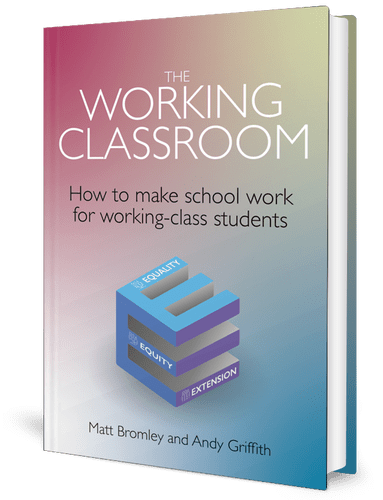
This is a version of an article by Matt Bromley which first appeared in Teach Secondary magazine and was written to accompany the book, The Working Classroom. If you’re a high-ability pupil from a working class background, you aren’t going to do as well in school and in later life as a low-ability pupil fromContinue reading “The meritocracy myth”
Category Archives: teaching
Intent, Implementation, Impact

60 self-evaluation questions to help you audit your curriculum In my 2016 book, Making KS3 Count, there’s a section called ‘Making Curriculum Count’ in which I advocate a more joined-up approach to curriculum design to ensure greater continuity across the various years, key stages and phases of education. I also advise that schools plan engaging curriculumsContinue reading “Intent, Implementation, Impact”
Why social class should be the 10th protected characteristic – PART ONE
This is a version of an article by Matt Bromley which has appeared in various publications including Headteacher Update, SecEd, and DiverseEd, written to accompany the book, The Working Classroom. The Equality Act 2010 makes it unlawful for schools to discriminate against, harass or victimise a pupil or potential pupil: …because of their: These sevenContinue reading “Why social class should be the 10th protected characteristic – PART ONE”
The questioning classroom: 5 practical questioning techniques

In this five-part series, Matt Bromley looks at how we can create a questioning classroom. In part five, he walks us through five practical questioning techniques which you can adopt and adapt for your classroom and teaching… In this final instalment, I would like to share five practical questioning techniques. 1, Hot-seating Hot-seating is aContinue reading “The questioning classroom: 5 practical questioning techniques”
The questioning classroom: The purpose and timing of questions

In this five-part series, Matt Bromley looks at how we can create a questioning classroom. In part four, he explores the purposes of our questions, timing our questions effectively, how we can ‘pass a question around the classroom’, and questions as a form of scaffolding… So far in this series, we have seen how askingContinue reading “The questioning classroom: The purpose and timing of questions”
The questioning classroom: How to encourage debate and discussion

In this five-part series, Matt Bromley looks at how we can create a questioning classroom. In part three, he explores ways of creating a classroom culture conducive to discussion and debate, including seven key rules, how to group students, and ways to reduce teacher talk… Last time, I explored a dialogic teaching strategy called SocraticContinue reading “The questioning classroom: How to encourage debate and discussion”
The questioning classroom: Socratic methods

In this five-part series, Matt Bromley looks at how we can create a questioning classroom. In part two, he explains 10 ways of questioning to promote critical thinking, looks at dialogic teaching, and offers a list of 38 Socratic questions… In part one, I said that open questions can be used to promote critical thinking.Continue reading “The questioning classroom: Socratic methods”
How to create a questioning classroom

Good questioning is at the heart of great teaching. In this five-part series for SecEd Magazine, Matt Bromley looks at creating a questioning classroom. In part one, he considers 13 questioning techniques, as well as six ways of using closed questions and nine ways to use open questions… At the heart of every good storyContinue reading “How to create a questioning classroom”
Why I wrote The Working Classroom
My new book, The Working Classroom, is out now. It explores ways of making school work for working-class students. Here, I explain why I wrote the book and what makes it so personal… I was born and brought up in a depressed northern town in the shadow of dark satanic mills and disappointment. My familyContinue reading “Why I wrote The Working Classroom”
How can we make English more real and relatable?

Matt Bromley was asked to contribute to a series of videos for Pearson Learning exploring ways of making English more real and relatable. You can watch those videos below. Here, he explains why English is the most important subject on the timetable and how we can make it talk to pupils’ lived experiences… This isContinue reading “How can we make English more real and relatable?”
 bee | Bromley Education Enterprises Limited