

This article was written for SecEd magazine and first published in May 2018. You can read the original version on the SecEd website here. You can access the full archive of my columns for SecEd here. So far in this series, I’ve argued that our obsession with feedback as the panacea for pupil progress and a proxyContinue reading “Feedback – the mark of success (Part Five)”
Author Archives: Administrator
Feedback – the mark of success (Part Four)

This article was written for SecEd magazine and first published in May 2018. You can read the original version on the SecEd website here. You can access the full archive of my columns for SecEd here. According to research, feedback is one of the most impactful strategies at a teacher’s disposal. It can add eight months ofContinue reading “Feedback – the mark of success (Part Four)”
Feedback – the mark of success (Part Three)

This article was written for SecEd magazine and first published in May 2018. You can read the original version on the SecEd website here. You can access the full archive of my columns for SecEd here. Several seminal works of educational research have espoused the virtues of feedback. First came Black and Wiliam’s Inside the Black Box,Continue reading “Feedback – the mark of success (Part Three)”
Feedback – the mark of success (Part Two)
This article was written for SecEd magazine and first published in May 2018. You can read the original version on the SecEd website here. You can access the full archive of my columns for SecEd here. Several seminal works of educational research have espoused the virtues of feedback. First came Black and Wiliam’s Inside the Black Box,Continue reading “Feedback – the mark of success (Part Two)”
Feedback – the mark of success (Part One)

This article was written for SecEd magazine and first published in May 2018. You can read the original version on the SecEd website here. You can access the full archive of my columns for SecEd here. On a recent family outing my teenage daughter turned to me and, with a pointed finger, ticked off my attire fromContinue reading “Feedback – the mark of success (Part One)”
How to motivate students (Part Two)
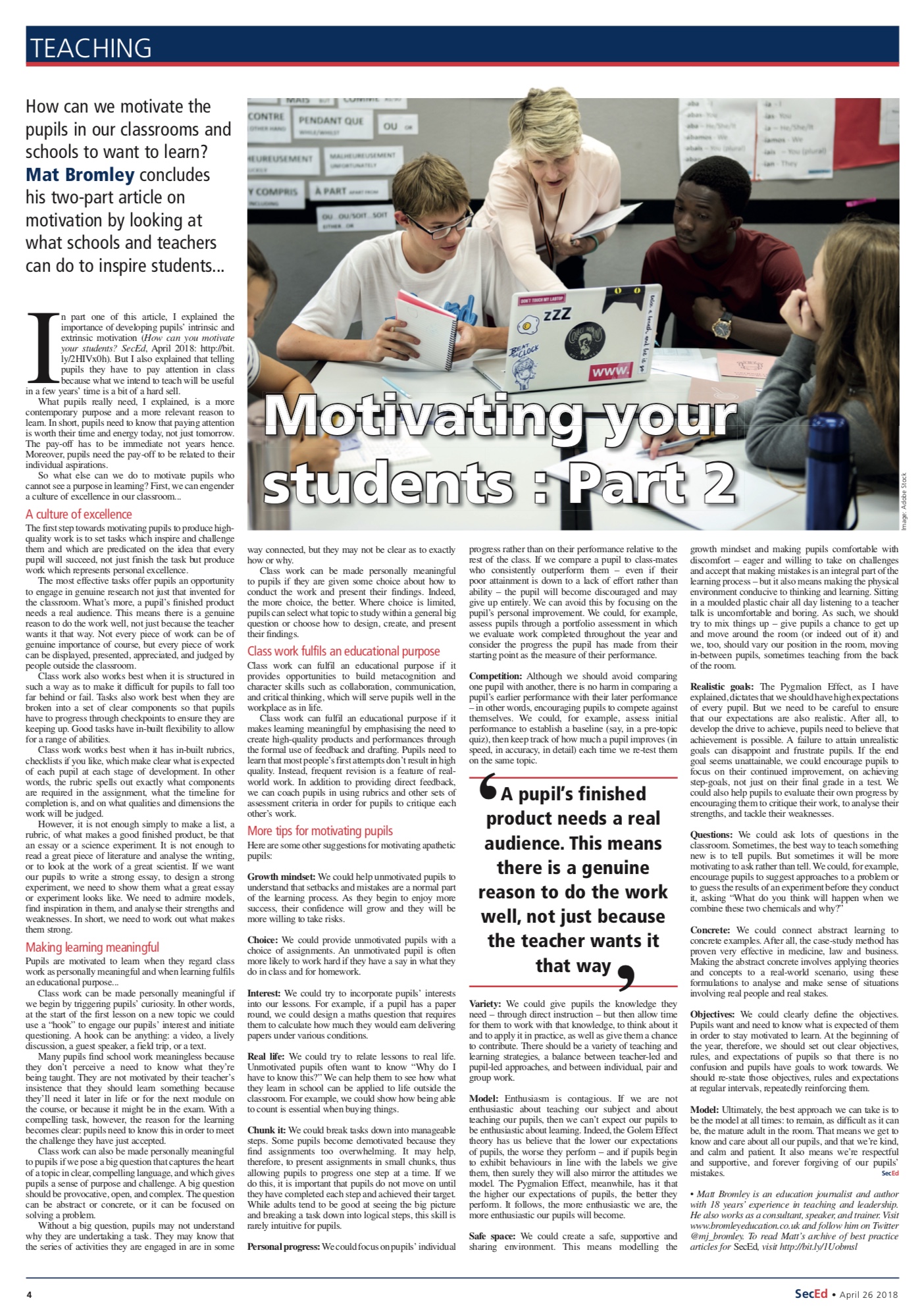
This article was written for SecEd magazine and first published in April 2018. You can read the original version on the SecEd website here. You can access the full archive of my columns for SecEd here. This is the second of a two-part article. Read the first part here. In part one of this article, I explainedContinue reading “How to motivate students (Part Two)”
How to motivate students (Part One)
This article was written for SecEd magazine and first published in April 2018. You can read the original version on the SecEd website here. You can access the full archive of my columns for SecEd here. When I first started exercising a couple of years ago, following a bout of ill-health, I could muster but 15 minutes’Continue reading “How to motivate students (Part One)”
Closing the vocabulary gap

This article was written for SecEd magazine and first published in March 2018. You can read the original version on the SecEd website here. You can access the full archive of my columns for SecEd here. When I spoke at SecEd’s Seventh National Pupil Premium and Ofsted Conference last year, I explained that one in four childrenContinue reading “Closing the vocabulary gap”
Ten top tips for improving storage in, and retrieval from, long-term memory

The process of learning is the interaction between our sensory memory and our long-term memory. Our sensory memory is made up of: what we see – this is called our iconic memory; what we hear – our echoic memory; and what we touch – our haptic memory. Our long-term memory is where new information isContinue reading “Ten top tips for improving storage in, and retrieval from, long-term memory”
Ten top tips for gaining the attention of working memory
The process of learning is the interaction between our sensory memory and our long-term memory. Our sensory memory is made up of: what we see – this is called our iconic memory; what we hear – this is called our echoic memory; and what we touch – our haptic memory. Our long-term memory is whereContinue reading “Ten top tips for gaining the attention of working memory”
 bee | Bromley Education Enterprises Limited