
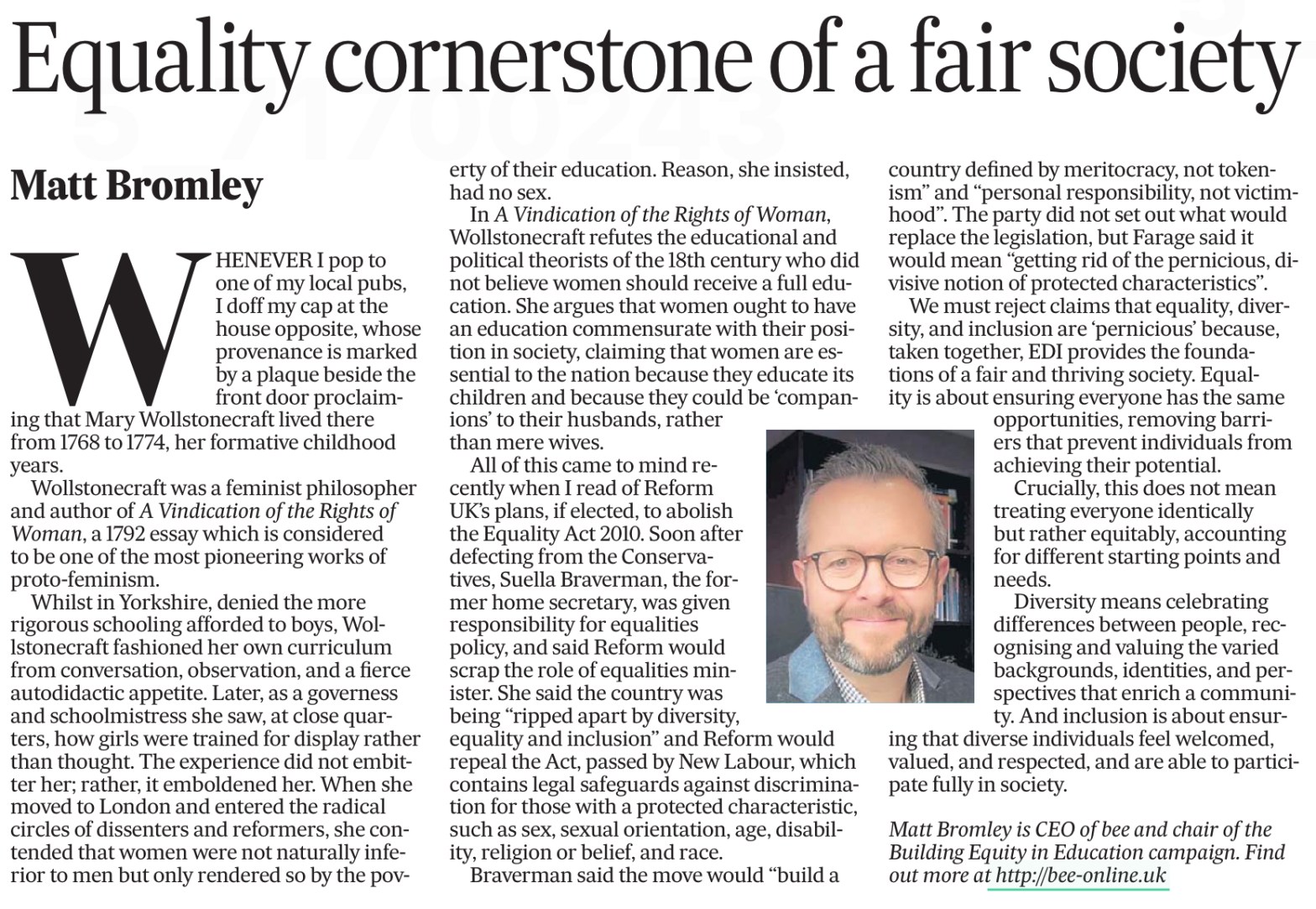
This is an edited version of an article that appeared in The Yorkshire Post on 27 March 2026 in which Matt Bromley argues that equality, diversity, and inclusion are the cornerstones of a fair and thriving society…
Whenever I pop to one of my local pubs, I doff my cap at the house opposite whose provenance is marked by a plaque beside the front door proclaiming that Mary Wollstonecraft lived there from 1768 to 1774, her formative childhood years. Wollstonecraft was a feminist philosopher and author of ‘A Vindication of the Rights of Woman’, a 1792 essay which is considered to be one of the most pioneering works of proto-feminism.
Whilst in Yorkshire, denied the more rigorous schooling afforded to boys, Wollstonecraft fashioned her own curriculum from conversation, observation, and a fierce autodidactic appetite. Later, as a governess and schoolmistress she saw, at close quarters, how girls were trained for display rather than thought. The experience did not embitter her; rather, it emboldened her. When she moved to London and entered the radical circles of dissenters and reformers, she contended that women were not naturally inferior to men but only rendered so by the poverty of their education. Reason, she insisted, had no sex.
In ‘A Vindication of the Rights of Woman’, Wollstonecraft refutes the educational and political theorists of the eighteenth century who did not believe women should receive a full education. She argues that women ought to have an education commensurate with their position in society, claiming that women are essential to the nation because they educate its children and because they could be ‘companions’ to their husbands, rather than mere wives. Instead of viewing women as ornaments to society or property to be traded in marriage, Wollstonecraft maintains that they are deserving of the same fundamental rights as men.
All of this came to mind recently when I read of Reform UK’s plans, if elected, to abolish the Equality Act 2010. Soon after defecting from the Conservatives, Suella Braverman, the former home secretary, was given responsibility for equalities policy, and said Reform would scrap the role of equalities minister. She said the country was being “ripped apart by diversity, equality and inclusion” and Reform would repeal the Act, passed by New Labour, which contains legal safeguards against discrimination for those with a protected characteristic, such as sex, sexual orientation, age, disability, religion or belief, and race.
Braverman said the move would “build a country defined by meritocracy, not tokenism” and “personal responsibility, not victimhood”. The party did not set out what would replace the legislation, but Farage said it would mean “getting rid of the pernicious, divisive notion of protected characteristics”.
The Prime Minister told the BBC that the pledge was “shocking” because the laws were “core” to British values and had given “decades of protection”, ensuring women and people of all races were “treated equally”. Keir Starmer added that the protections in the Act are about “basic values, one of which is [that] women be treated equally with men.”
We must reject claims that equality, diversity, and inclusion are “pernicious” because, taken together, EDI provide the foundations of a fair and thriving society. Equality is about ensuring everyone has the same opportunities, removing barriers that prevent individuals from achieving their potential. Crucially, this does not mean treating everyone identically but rather equitably, accounting for different starting points and needs. Diversity means celebrating differences between people, recognising and valuing the varied backgrounds, identities, and perspectives that enrich a community. And inclusion is about ensuring that diverse individuals feel welcomed, valued, and respected, and are able to participate fully in society.
EDI isn’t ripping the country apart; it’s what binds us together. The culture war mongering of Farage and his cronies is the real cause of division and must be rejected at every turn.
Read more of Matt’s columns for The Yorkshire Post…

 bee | Bromley Education Enterprises Limited