
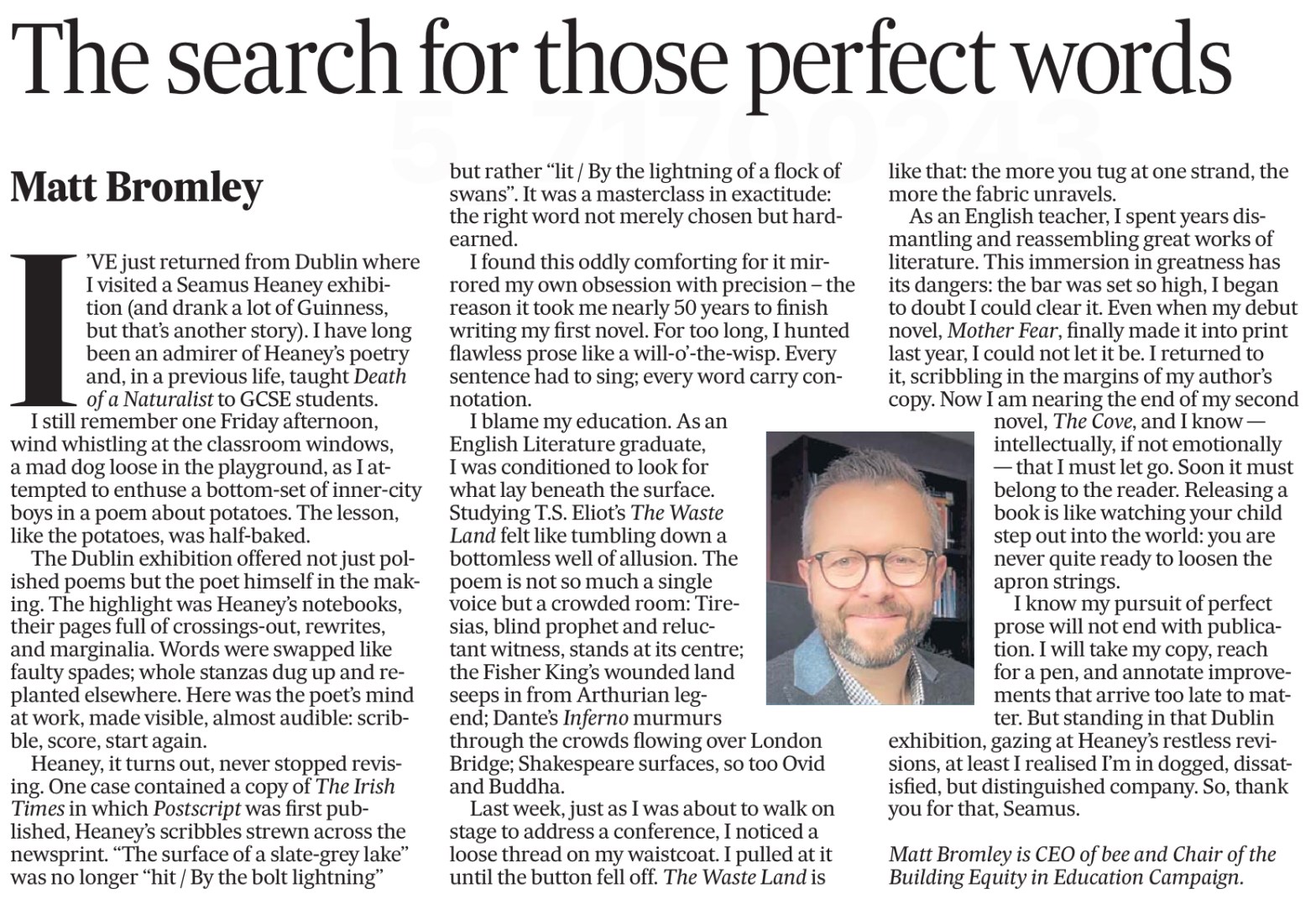
This is an edited version of an article that appeared in The Yorkshire Post on 11 February 2026 in which Matt Bromley recounts a recent visit to Dublin…
I’ve just returned from Dublin where I visited a Seamus Heaney exhibition (and drank a lot of Guinness, but that’s another story). I have long been an admirer of Heaney’s poetry and, in a previous life, taught Death of a Naturalist to GCSE students. I still remember one Friday afternoon, wind whistling at the classroom windows, a mad dog loose in the playground (teachers will recognise the electric effect such chaos can have on children), as I attempted to enthuse a bottom-set of inner-city boys in a poem about potatoes. The lesson, like the potatoes, was half-baked.
The Dublin exhibition offered not just polished poems but the poet himself in the making. The highlight was Heaney’s notebooks, their pages full of crossings-out, rewrites, and marginalia. Words were swapped like faulty spades; whole stanzas dug up and replanted elsewhere. Here was the poet’s mind at work, made visible, almost audible: scribble, score, start again.
Heaney, it turns out, never stopped revising. One case contained a copy of The Irish Times in which Postscript was first published, Heaney’s scribbles strewn across the newsprint. “The surface of a slate-grey lake” was no longer “hit / By the bolt lightning” but rather “lit / By the lightning of a flock of swans”. It was a masterclass in exactitude: the right word not merely chosen but hard-earned.
I found this oddly comforting for it mirrored my own obsession with precision – the reason it took me nearly fifty years to finish writing my first novel. For too long, I hunted flawless prose like a will-o’-the-wisp. Every sentence had to sing; every word carry connotation. A word could not simply ‘be’; it had to ‘mean’. Tone, cadence, texture: nothing escaped scrutiny.
I blame my education. As an English Literature graduate, I was conditioned to look for what lay beneath the surface. Studying T.S. Eliot’s The Waste Land felt like tumbling down a bottomless well of allusion. The poem is not so much a single voice but a crowded room: Tiresias, blind prophet and reluctant witness, stands at its centre; the Fisher King’s wounded land seeps in from Arthurian legend; Dante’s Inferno murmurs through the crowds flowing over London Bridge; Shakespeare surfaces, so too Ovid and Buddha. Last week, just as I was about to walk on stage to address a conference, I noticed a loose thread on my waistcoat. I pulled at it until the button fell off. The Waste Land is like that: the more you tug at one strand, the more the fabric unravels.
As an English teacher, I spent years dismantling and reassembling great works of literature. This immersion in greatness has its dangers: the bar was set so high, I began to doubt I could clear it. And so, my early novels, short stories, and poems ended not as printed text, but crumpled paper in the bin.
Even when my debut novel, Mother Fear, finally made it into print last year, I could not let it be. I returned to it, scribbling in the margins of my author’s copy, cursing convolution, cringing at clunky word-choices.
Now I am nearing the end of my second novel, The Cove, and I know — intellectually, if not emotionally — that I must let go. Soon it must belong to the reader. Releasing a book is like watching your child step out into the world: you are never quite ready to loosen the apron strings.
I know my pursuit of perfect prose will not end with publication. I will take my copy, reach for a pen, and annotate improvements that arrive too late to matter. But standing in that Dublin exhibition, gazing at Heaney’s restless revisions, at least I realised I’m in dogged, dissatisfied, but distinguished company. So, thank you for that, Seamus.
Read more of Matt’s columns for The Yorkshire Post…

 bee | Bromley Education Enterprises Limited