
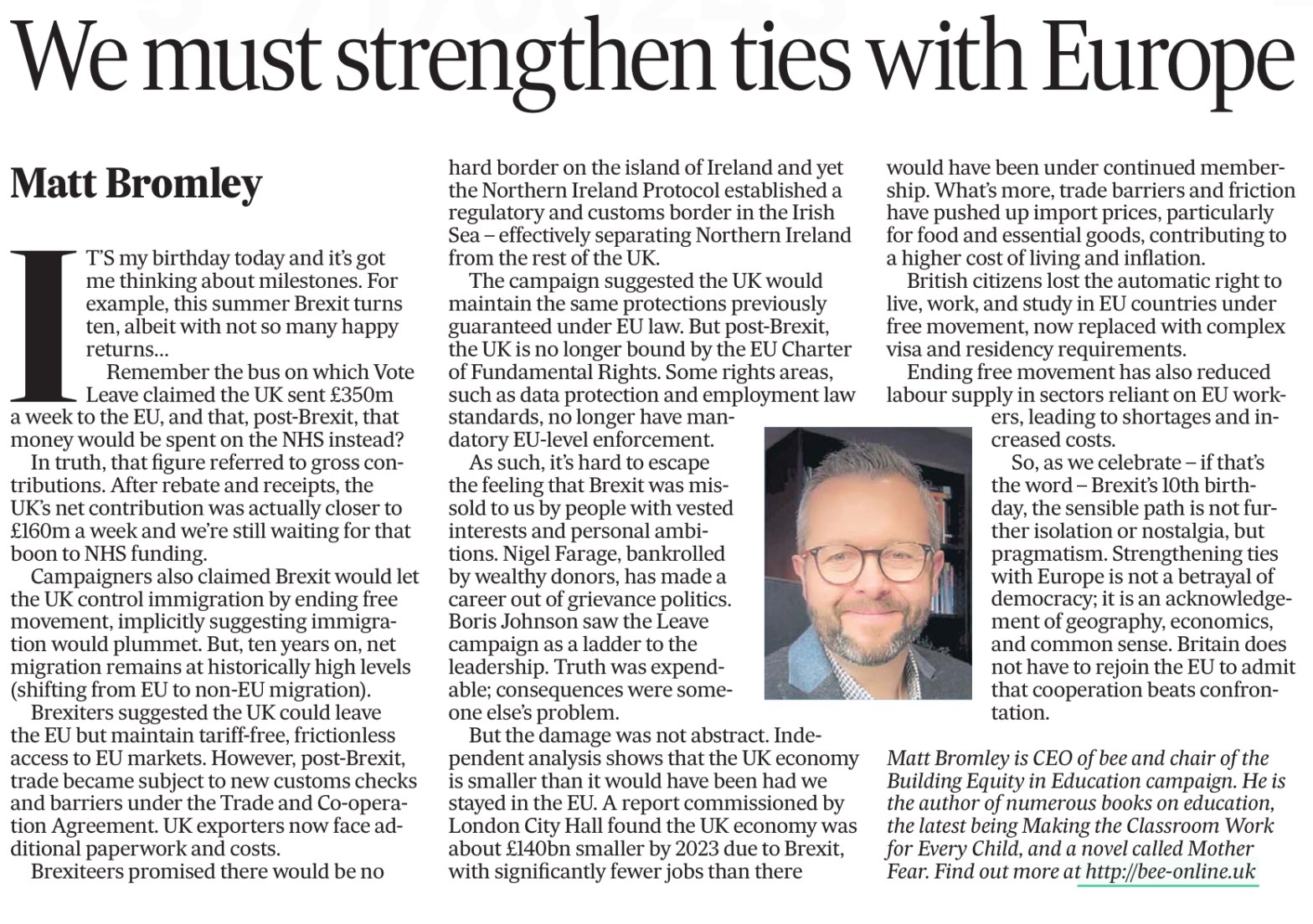
This is an edited version of an article that appeared in The Yorkshire Post on 27 January 2026 in which Matt Bromley argues that it’s time to strengthen ties with Europe once more…
It’s my birthday today and it’s got me thinking about milestones: For example, this summer Brexit turns ten, albeit with not so many happy returns…
Remember the bus on which Vote Leave claimed the UK sent £350 million a week to the EU, and that, post-Brexit, that money would be spent on the NHS instead? In truth, that figure referred to gross contributions. After rebate and receipts, the UK’s net contribution was actually closer to £160 million a week and we’re still waiting for that boon to NHS funding.
Campaigners also claimed Brexit would let the UK control immigration by ending free movement, implicitly suggesting immigration would plummet. But, ten years on, net migration remains at historically high levels (shifting from EU to non-EU migration).
Brexiters suggested the UK could leave the EU but maintain tariff-free, frictionless access to EU markets. However, post-Brexit, trade became subject to new customs checks and barriers under the Trade and Co-operation Agreement. UK exporters now face additional paperwork and costs. And what of those major global trade deals we were promised? Whilst some deals (e.g. with Japan) were agreed at the point of departure, most trade negotiations have been ongoing for years, and significant deals (including with the US) remain elusive or much more limited than those with the EU.
Brexiteers promised there would be no hard border on the island of Ireland and yet the Northern Ireland Protocol established a regulatory and customs border in the Irish Sea — effectively separating Northern Ireland from the rest of the UK.
The campaign suggested the UK would maintain the same protections previously guaranteed under EU law. But post-Brexit, the UK is no longer bound by the EU Charter of Fundamental Rights. Some rights areas, such as data protection and employment law standards, no longer have mandatory EU-level enforcement.
As such, it’s hard to escape the feeling that Brexit was mis-sold to us by people with vested interests and personal ambitions. Nigel Farage, bankrolled by wealthy donors, has made a career out of grievance politics. Boris Johnson saw the Leave campaign as a ladder to the leadership. Truth was expendable; consequences were someone else’s problem.
But the damage was not abstract… Independent analysis shows that the UK economy is smaller than it would have been had we stayed in the EU. A report commissioned by London City Hall found the UK economy was about £140 billion smaller by 2023 due to Brexit, with significantly fewer jobs than there would have been under continued membership. What’s more, trade barriers and friction have pushed up import prices, particularly for food and essential goods, contributing to a higher cost of living and inflation.
British citizens lost the automatic right to live, work, and study in EU countries under free movement, now replaced with complex visa and residency requirements. Programmes like Erasmus+, which enabled UK students and young people to study and work across Europe, are no longer automatically available, reducing educational and cultural exchange opportunities. UK citizens now face limitations on time spent in EU countries (chiefly the “90-day rule”), and new authorisation systems (e.g., ETIAS) will add costs and bureaucracy to travel. Ending free movement has also reduced labour supply in sectors reliant on EU workers (like hospitality, agriculture and healthcare), leading to labour shortages and increased costs.
So, as we celebrate – if that’s the word – Brexit’s 10th birthday, the sensible path is not further isolation or nostalgia, but pragmatism. Strengthening ties with Europe — on trade, research, education, security, and mobility — is not a betrayal of democracy; it is an acknowledgement of geography, economics, and common sense. Britain does not have to rejoin the EU to admit that cooperation beats confrontation.
Read more of Matt’s columns for The Yorkshire Post…

 bee | Bromley Education Enterprises Limited