

In the fifth of six articles originally published in SecEd Magazine, Matt Bromley analyses Ofsted’s new evaluation areas. In this article, he explores personal development…
Ofsted’s new inspection framework has been unveiled and is rolling out this month (November). In this series, I am exploring the six core evaluation areas that schools are to be judged upon in the new report cards.
Please do not interpret my advice as constituting a checklist; rather, it is a sense-check, a way of helping you start a conversation with colleagues about your daily practice and your evidence-base. Use your professional judgement throughout: take away anything you think will be helpful but ignore anything that doesn’t fit your context.
In this, part 5, I will be focusing on personal development and wellbeing.
Key questions
At its most basic, inspectors are looking to answer four questions about personal development and wellbeing:
- Do leaders establish a suitable and coherent programme of personal development, through both the curriculum and the wider opportunities and experiences they provide for pupils?
- Does the school support pupils to develop the knowledge and skills they need for participation and success in later life?
- Does the school promote pupils’ wider development, character and wellbeing, ensuring that they receive the care and support to achieve and thrive, in school and beyond?
- Does the school offer pupils spiritual, moral, social and cultural (SMSC) development across its activities?
Inspectors will focus on gathering evidence relating to the factors that statutory and non-statutory guidance, research and inspection evidence indicate contribute most strongly to personal development and wellbeing. These factors are as follows:
- Ensuring that the curriculum contributes to pupils’ personal and SMSC development.
- Supporting pupils to become responsible, respectful and active citizens who can play their part in public life as young people and adults.
- Developing and deepening pupils’ understanding of the fundamental British values of democracy, the rule of law, individual liberty, and mutual respect and tolerance of those with different faiths and beliefs.
- Promoting equality of opportunity so that all pupils can thrive together and understand that individual characteristics make people unique; this includes, but is not limited to, an age- appropriate understanding of the protected characteristics defined in the Equality Act 2010.
- Developing pupils’ character so that they reflect wisely, learn eagerly, behave with integrity, and cooperate consistently well with others.
- Developing pupils’ confidence, resilience and knowledge so that they can keep themselves mentally healthy.
- Enabling pupils to recognise online and offline risks to their wellbeing – for example, risks from criminal and sexual exploitation, domestic abuse, female genital mutilation, forced marriage, substance misuse, gang activity, radicalisation and extremism – and making them aware of the support that is available.
- Enabling pupils to recognise the dangers of using technology and social media inappropriately.
- Developing pupils’ understanding of how to keep physically healthy, eat healthily and maintain an active lifestyle, including by providing them with enrichment activities and opportunities to be active during the school day.
- Developing pupils’ age-appropriate understanding of healthy relationships through relationships and sex education.
- Supporting pupils’ readiness for the next phase of education, training or employment so that they are equipped to make the transition successfully, including by providing impartial careers information, education, advice and guidance for secondary-age pupils.
So, what might this look like in practice? Let’s explore each factor in turn…
1, Ensuring that the curriculum contributes to pupils’ personal and SMSC development
What it might look like in practice:
- SMSC embedded across subjects, not only in PSHE/RE.
- Cross-curricular links (e.g. history lessons on democracy, science lessons on ethics).
- Regular opportunities for reflection and discussion.
Actions to take:
- Audit curriculum to identify SMSC coverage.
- Train staff to highlight SMSC links in everyday teaching.
- Build regular assemblies and tutor time themes around SMSC priorities.
How to prepare:
- Keep a curriculum map showing SMSC integration.
- Collect examples of pupil work demonstrating SMSC reflection.
- Ensure staff can articulate SMSC intent and impact.
2, Supporting pupils to become responsible, respectful, and active citizens
What it might look like in practice:
- Pupil leadership opportunities (school council, eco-groups).
- Active community involvement (charity fundraising, volunteering).
- Respectful behaviour embedded in culture.
Actions to take:
- Establish structured pupil leadership programmes.
- Partner with local charities/community groups.
- Explicitly teach citizenship through PSHE and curriculum subjects
How to prepare:
- Keep minutes and outcomes of student council meetings.
- Record community engagement projects.
- Gather pupil voice on how they contribute as citizens.
3, Developing understanding of fundamental British values (FBV)
What it might look like in practice:
- Visible in displays, assemblies, and lessons.
- Pupils can explain concepts of democracy, rule of law, liberty, and tolerance.
- Curriculum includes case studies and debates on current affairs.
Actions to take:
- Plan annual FBV themes in assemblies/tutor time.
- Provide opportunities for pupils to experience democracy (mock elections, debates).
- Train staff to model and explain FBV in daily practice.
How to prepare:
- Collect examples of FBV in curriculum planning.
- Keep records of assemblies, student councils, debates.
- Ensure pupils can confidently explain FBV in pupil voice.
4, Promoting equality of opportunity
What it might look like in practice:
- Inclusive curriculum with diverse role models.
- Protected characteristics taught in age-appropriate ways.
- High aspirations for all groups of pupils.
Actions to take:
- Review curriculum resources for representation.
- Deliver staff CPD on Equality Act duties.
- Challenge stereotypes in lessons and wider school life.
How to prepare:
- Keep an equality action plan and impact review.
- Collect evidence of enrichment opportunities for disadvantaged groups.
- Record assemblies/workshops on diversity and inclusion.
5, Developing pupils’ character
What it might look like in practice:
- Pupils demonstrate integrity, resilience, and team-work.
- Reward systems recognise effort, kindness, and collaboration.
- Pupils engage in projects requiring perseverance.
Actions to take:
- Embed character education in curriculum and enrichment.
- Set up reflection journals or mentoring sessions.
- Celebrate positive behaviours consistently.
How to prepare:
- Document how character traits are explicitly taught.
- Collect pupil work/reflections showing resilience.
- Showcase enrichment opportunities that build team-work.
6, Developing pupils’ confidence, resilience and knowledge for mental health
What it might look like in practice:
- Mental health discussed openly and positively.
- Pupils know coping strategies and support available.
- Staff trained in early identification of mental health needs.
Actions to take:
- Implement a whole-school wellbeing policy.
- Train staff in Mental Health First Aid.
- Run wellbeing workshops and awareness days.
How to prepare
- Keep records of staff training.
- Gather case studies showing support and outcomes.
- Collate pupil voice on wellbeing support.
7, Enabling pupils to recognise offline and online risks
What it might look like in practice:
- Pupils can articulate risks (exploitation, radicalisation, abuse).
- Regular safeguarding curriculum woven into PSHE, ICT, assemblies.
- Pupils know where to seek help.
Actions to take:
- Map safeguarding themes across curriculum.
- Use external agencies (police, NSPCC, CEOP) for workshops.
- Train staff to respond to disclosures appropriately.
How to prepare:
- Collect safeguarding curriculum map.
- Record workshop attendance and feedback..
- Maintain case logs showing effective support.
8, Recognising dangers of technology and social media
What it might look like in practice:
- Pupils demonstrate safe and critical use of technology.
- Digital wellbeing policies shared with pupils and parents.
- Age-appropriate filtering and monitoring systems in place.
Actions to take:
- Deliver regular e-safety sessions to pupils and parents.
- Review and update filtering systems.
- Embed digital citizenship into ICT curriculum.
How to prepare:
- Store parent workshop materials.
- Keep logs of e-safety curriculum delivery.
- Gather pupil voice on online safety confidence.
9, Keeping physically healthy, active and eating well
What it might look like in practice:
- Healthy food options promoted in school.
- Daily activity opportunities (PE, active breaks, clubs).
- Pupils understand the benefits of active lifestyle.
Actions to take:
- Partner with catering provider to improve healthy options.
- Ensure all pupils access two hours of PE weekly.
- Run health weeks and sports festivals.
How to prepare:
- Keep PE curriculum plans and participation records.
- Collect pupil voice on healthy eating and activity.
- Showcase sports day, clubs and health initiatives.
10, Understanding healthy relationships (RSE)
What it might look like in practice:
- Pupils can articulate safe, respectful and healthy relationships.
- Clear age-appropriate RSE curriculum in place.
- Pupils know how to access support if needed.
Actions to take:
- Map statutory RSE requirements across key stages.
- Involve parents through consultations and resources.
- Train staff in delivering sensitive topics effectively.
How to prepare:
- Keep RSE curriculum plan and consultation records.
- Collect anonymised pupil feedback on RSE provision.
- Ensure staff can explain how RSE supports safeguarding.
11. Supporting pupils’ readiness for the next phase
What it might look like in practice:
- Pupils confident in transitions and career planning.
- Access to impartial careers advice and experiences of work.
- Leavers achieve sustained education, training or employment destinations.
Actions to take:
- Develop careers programme (aligned with Gatsby Benchmarks).
- Provide taster days, college/apprenticeship visits.
- Track post-16/18 destinations.
How to prepare:
- Keep evidence of careers programme, employer links, work experience logs.
- Collect destination data.
- Ensure pupils can articulate aspirations and next steps.
Taking account of context
The inspection toolkit (Ofsted, 2025) says that, when considering the factors above, inspectors will take account of how they apply to different ages and stages of learning, and the needs of different groups of pupils. Inspectors will:
- Seek to understand the school’s priorities for the personal development of individual pupils and its approaches to developing and providing a personal development programme, including careers education, matched to pupils’ needs.
- Understand that pupils’ participation in enrichment opportunities may vary according to their needs/circumstances.
- Recognise that these pupils may face increased risks relating to their age rather than their developmental stage; inspectors want to understand how the school supports pupils with SEND to access, in ways that are developmentally suitable, the age-appropriate content they need to keep themselves healthy and safe.
Gathering evidence of ‘personal development and wellbeing’
In gathering evidence about the strategic leadership of personal development and wellbeing, inspectors will consider the extent to which:
- Leaders ensure that the personal development programme (taught content and wider opportunities and experiences) is broad, coherently planned and suitable for the school’s context, and that the programme and the school’s wider work reinforce one another.
- Leaders ensure that staff have the knowledge and skills they need to teach the content of the personal development programme, and that this content is planned, taught and assessed in line with the best available evidence.
Let’s have a look at what this might mean in practice…
1, Broad, coherent, suitable for context, and reinforced through wider work
What it might look like in practice:
- A clearly mapped programme of personal development (PSHE, RSE, SMSC, careers, enrichment) with progression across year groups.
- Regularly reviewed to reflect pupil needs (e.g. safeguarding trends, local risks, diversity of the community).
- Enrichment activities (e.g. clubs, trips, volunteering, leadership roles) explicitly linked to taught content.
- Assemblies, displays, and tutor programmes reinforcing key themes (e.g. British values, resilience, wellbeing).
Leadership actions:
- Audit existing provision against statutory and non-statutory guidance.
- Map-out curriculum intent for personal development, showing coherence and sequencing.
- Gather pupil, parent, and staff voice to ensure it reflects the school’s context.
- Ensure personal development is regularly discussed at senior leadership/governor level.
- Monitor uptake of wider opportunities to ensure equity of access (e.g. disadvantaged pupils).
Evidence file:
- A curriculum overview map for personal development (PSHE, RSE, SMSC, careers).
- Enrichment programme schedule with participation records.
- Minutes from pupil voice forums or surveys.
- Links between taught curriculum and assemblies/clubs.
- Governor reports or senior leadership minutes demonstrating review and oversight.
Top tip: Create a one-page personal development overview that shows: curriculum map, enrichment offer, how both reinforce each other, and how equity of access is ensured.
2, Knowledge and skills to teach personal development…
What it might look like in practice:
- Staff delivering PSHE/RSE receive training and support, particularly for sensitive or statutory content.
- High-quality resources are selected (evidence-informed, age-appropriate, inclusive).
- Assessment methods are used to check understanding (quizzes, reflection tasks, discussions).
- Staff feel confident dealing with questions and safeguarding disclosures.
Leadership actions:
- Audit staff confidence and training needs in teaching PSHE/RSHE/personal development.
- Provide CPD (e.g. external experts, online training, safeguarding updates).
- Ensure curriculum planning uses trusted sources (e.g. DfE, PSHE Association, NHS).
- Moderate delivery quality through learning walks, book looks, and pupil feedback.
- Build assessment into the programme (baseline knowledge checks, end-of-unit reviews).
Evidence file:
- CPD logs and staff training records.
- Lesson plans/resources showing use of best available evidence.
- Records of staff confidence audits and actions taken.
- Assessment tools used in PSHE/RSE.
- Evaluation reports showing impact (e.g. improved understanding of online safety).
Top tip: Keep a staff training tracker specifically for personal development (including safeguarding, PSHE, RSE, online safety) – inspectors often ask how leaders ensure staff are confident and up-to-date
Next time: I’ll be back next week when I will explore leadership and governance
I hope you found that useful. Get in touch if you have questions.
If you want more help, check out the book…

This book is a repost to the snake oil salesmen who’ll tell you what to do to impress inspectors. Don’t be fooled by the title – the subtitle is doing the heavy-lifting. It’s about doing what’s right for your pupils every day, not what’s right for inspectors during their two-day visit. Yes, it unpacks the new framework in a way that makes sense to busy school leaders and teachers, and yes it offers loads of practical tools that will help you evidence what you do, but the advice and resources you”ll find in this book are about the long-haul of genuine and sustainable school improvement, not quick fixes. If in doubt, read a sample of the book, you might be pleasantly surprised!
And consider booking Matt to deliver training in your school…
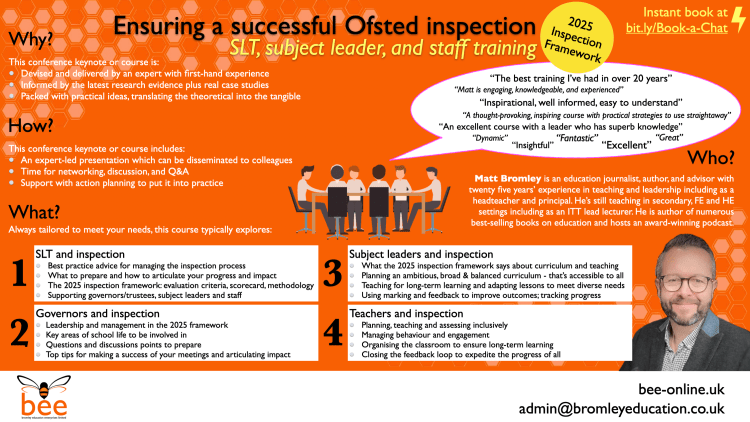
Here’s what colleagues who’ve recently attended Matt’s inspection training have had to say…
“Informative and knowledgeable leader who was both engaging and insightful.”
“Excellent!”
“Very useful – it got us to drill down and reflect on our own practice.”
“Very informative with clear strategic ideas.”
“A very welcome overview of the process.”
“Really informative – it’s made me feel a lot clearer as a new Headteacher of what I need to do to prepare for OFSTED.”
“Very helpful and covered all the main areas.”
“Very thorough and the presenter was engaging.”
“Very informative and thought provoking.”
“Really informative, well-paced, and gave me the information I needed.”
 bee | Bromley Education Enterprises Limited