

In the fourth of six articles originally published in SecEd Magazine, Matt Bromley analyses Ofsted’s new evaluation areas. In this article, he explores attendance and behaviour…
Ofsted’s new inspection framework has been unveiled and will be introduced from November.
I wrote previously dissecting key aspects of the framework and setting out some initial actions that school leaders might consider.
I am now, in this series, exploring the six core evaluation areas that schools are to be judged upon in the new report cards.
As I said last time, please do not interpret my advice as constituting a checklist; rather, it is a sense-check, a way of helping you start a conversation with colleagues about your daily practice and your evidence-base. Use your professional judgement throughout: take away anything you think will be helpful but ignore anything that doesn’t fit your context or approach.
In this, part 4 of our series, I will be focusing on attendance and behaviour.
Key questions
At its most basic, inspectors are looking to answer two questions about attendance and behaviour:
- Do leaders and other staff create a calm, orderly, respectful, supportive and positive environment in which pupils can thrive?
- What is the impact of the school’s work on the attendance, behaviour and attitudes of all pupils, especially disadvantaged pupils, those with SEND, those who are known (or previously known) to children’s social care, and those who may face other barriers to their learning and/or wellbeing, such as young carers?
Inspectors will focus on gathering evidence relating to the following factors:
- Prioritising pupils’ attendance and punctuality, as well as their positive behaviour and attitudes to learning.
- Fostering a positive and respectful culture in which staff know, support and care about pupils, including the groups listed above.
- Having clear policies for attendance and behaviour that are applied effectively and proportionately.
- Staff applying clearly defined consequences consistently and fairly when needed.
- Setting clear routines and expectations for pupils’ behaviour across all aspects of school life, not just in the classroom.
- Developing pupils’ motivation and positive attitudes to learning, since these are important predictors of attainment and instil important behaviours for future learning.
- Creating an environment in which pupils feel safe, and in which bullying, unlawful discrimination, harassment (including sexual harassment), victimisation, physical and sexual abuse and/or violence and emotional abuse – online or offline – are not accepted and are dealt with quickly, consistently and effectively.
So, what might this look like in practice? Let’s explore each factor in turn…
1, Prioritising pupils’ attendance, punctuality, positive behaviour, and attitudes to learning
What it might look like in practice:
- Leaders regularly review attendance data and intervene quickly where patterns emerge.
- Punctuality is monitored at the start of the day and in lessons.
- Pupils demonstrate focus and resilience in lessons.
Actions to take:
- Implement an attendance strategy with clear escalation routes.
- Track data by pupil groups (SEND, disadvantaged, social care).
- Incentivise improved attendance and punctuality (rather than rewarding 100%).
- Train staff to build positive attitudes through high-quality teaching and relationships.
How to prepare:
- Have termly attendance reports and impact evaluations ready.
- Be able to show how interventions improved attendance and attitudes, then engagement, progress, and outcomes.
2, Fostering a positive and respectful culture where staff know, support, and care about pupils
What it might look like in practice:
- Pupils say staff know them well and take time to support their needs.
- Relationships are warm but purposeful, with high expectations.
Actions to take:
- Embed staff CPD on relational practice and inclusive teaching.
- Ensure staff know individual pupils’ needs (via pastoral briefings, pupil profiles).
- Promote positive role modelling from staff.
How to prepare:
- Collect pupil/parent voice surveys.
- Provide case studies of staff supporting vulnerable pupils effectively.
3, Clear policies for attendance and behaviour applied effectively and proportionately
What it might look like in practice:
- Staff and pupils can articulate the school’s behaviour and attendance policy.
- Responses to poor behaviour are consistent and proportionate.
Actions to take:
- Review policies annually; communicate to staff, pupils, parents.
- Audit consistency in applying policy across the school.
- Use restorative approaches where appropriate.
How to prepare:
- Keep evidence of staff training, policy communication, and governor review.
- Provide logs of exclusions/suspensions showing fair application.
4, Staff apply clearly defined consequences consistently and fairly
What it might look like in practice:
- Pupils understand consequences and say they are fair.
- Staff implement sanctions predictably without escalation bias.
Actions to take:
- Staff CPD on behaviour management.
- Monitor sanction data by pupil group.
- Calibrate responses across year groups/departments.
How to prepare:
- Have ready behaviour logs, analysis by group, and evidence of training.
- Prepare examples of how consistency has improved behaviour climate.
5, Clear routines and expectations across all aspects of school life
What it might look like in practice:
- Pupils follow shared routines (lining up, transitions, assemblies, break times).
- Behaviour expectations extend beyond the classroom (corridors, playgrounds, trips).
Actions to take:
- Co-create routines with staff and pupils.
- Reinforce expectations through assemblies and tutor time.
- Monitor non-classroom behaviour through duty systems.
How to prepare:
- Gather staff/pupil voice on routines.
- Document supervision rotas and impact evaluations.
6, Develop pupils’ motivation and positive attitudes to learning
What it might look like in practice:
- Pupils demonstrate perseverance in challenging tasks.
- High engagement visible in lessons and enrichment.
Actions to take:
- Train staff on growth mindset and resilience approaches.
- Provide enriching curriculum opportunities that inspire pupils.
- Reward positive learning behaviours explicitly.
How to prepare:
- Collect pupil work samples showing persistence and improvement.
- Document enrichment participation and impact.
7, Create a safe environment free from bullying, harassment, or abuse
What it might look like in practice:
- Pupils feel safe and confident to report concerns.
- Bullying and harassment are rare and dealt with effectively.
Actions to take:
- Maintain up-to-date safeguarding training for all staff.
- Establish strong anti-bullying and peer support programmes.
- Monitor safeguarding logs and evaluate patterns.
How to prepare:
- Prepare safeguarding case audits and anonymised logs.
- Collect pupil voice showing they feel safe in school and know how to report issues.
Taking account of context
The inspection toolkit says that, when considering the factors above, inspectors should take account of how they apply to different ages and stages of learning, and the needs of different groups of pupils.
For pupils with SEND, inspectors should:
- Consider how leaders and staff support pupils with emotional, mental health or medical needs that affect attendance, and how they help these pupils to attend more regularly (this may include working with parents and professionals).
- Bear in mind that some pupils may need additional support to help them manage their behaviour and emotional regulation.
- Explore leaders’ work over time and its impact on helping pupils to meet high expectations.
- Consider how leaders and staff work with medical professionals and other specialists to support access to education and attendance at school, as appropriate, for pupils who are educated under Section 19 (Education Act 1996) duties because they are unwell, including those educated in hospitals.
Ofsted acknowledges that some schools have a significant proportion of pupils who join with previously low attendance or following disruption to their education. In these schools, inspectors will recognise that this may affect overall attendance or rates of persistent absence. They will therefore pay particular attention to the impact of the school’s work to improve attendance rapidly for these pupils and to maintain improvements over time.
Gathering evidence of attendance and behaviour
In gathering evidence about the strategic leadership of attendance and behaviour, inspectors will consider the extent to which leaders:
- Know and understand their pupils, the influences on them given the context of the school, and the challenges they may face in maintaining positive behaviour.
- Promote good attitudes to learning and regular attendance, especially for disadvantaged pupils, those with SEND, those who are known (or previously known) to children’s social care, and those who may face other barriers to their learning and/or wellbeing.
- Pay close attention to every element of the school’s work to make sure that the school is a place that pupils want to attend.
- Have high expectations for all pupils’ attendance, behaviour and attitudes, and design effective policies that communicate these high expectations clearly to all staff, pupils and parents, including expectations related to mobile phones.
- Implement agreed policies effectively so that they are applied consistently by staff.
- Have an informed and accurate understanding of what is working well and where improvement is needed, including through using day-to-day processes and detailed data analysis to identify, anticipate, prevent and improve poor attendance and behaviour, including bullying.
- Have developed a clear, strategic plan to tackle improvement priorities, demonstrate a record of improvement and ensure a high standard of attendance, behaviour and attitudes.
Let’s have a look at what this might mean in practice for school leaders and teachers…
1, Leaders know and understand their pupils, the influences on them, and the challenges they face
Leadership actions:
- Conduct regular pupil voice surveys, focus groups, and pastoral check-ins to understand barriers.
- Map vulnerable groups and monitor patterns (e.g. SEND, disadvantaged, social care).
- Train staff to recognise contextual influences (family, community, socio-economic factors).
Evidence file:
- Pupil voice records, survey summaries, case studies.
- Attendance/behaviour data broken down by group.
- Training logs on contextual safeguarding and trauma-informed practice.
Top tip: Keep case studies ready to show inspectors how you know your pupils beyond the data.
2, Leaders promote good attitudes to learning and regular attendance for key groups
Leadership actions:
- Establish targeted mentoring, attendance clinics, and breakfast clubs for disadvantaged/SEND pupils.
- Explicitly promote attendance and behaviour in assemblies, newsletters, and parent communications.
- Link attendance rewards to effort, resilience, and positive learning habits.
Evidence file:
- Records of interventions for key groups.
- Parental engagement logs.
- Examples of assemblies/newsletters emphasising attendance and learning attitudes.
Top tip: Demonstrate how interventions reduce barriers (e.g. breakfast club data showing improved punctuality)
3, Leaders pay close attention to every element of school life so pupils want to attend
Leadership actions:
- Ensure curriculum breadth, enrichment, and the extra-curricular offer is attractive to all groups, and target/fund access for those who need it most (e.g. disadvantaged and vulnerable pupils).
- Build a safe, welcoming culture where relationships are central.
- Review pupil feedback on enrichment and adapt offer accordingly.
Evidence file:
- Extra-curricular registers and participation data by group.
- Pupil survey responses on belonging and motivation.
- Examples of curriculum adaptation to reflect pupil interests.
Top tip: Inspectors often ask pupils: “Do you like coming to school?” Prepare pupil ambassadors to confidently share positive experiences.
4, Leaders set high expectations for attendance, behaviour and attitudes (including mobile phones)
Leadership actions:
- Co-create and communicate clear policies on behaviour, attendance, and mobile phone use.
- Share policies with parents/carers and ensure consistency in application.
- Model high expectations through leadership visibility.
Evidence file:
- Published policy documents.
- Records of parent/carer communication.
- Monitoring reports showing consistency of application.
Top tip: Be ready to explain why you chose your mobile phone policy and show that it works.
5, Leaders implement policies consistently
Leadership actions:
- Train all staff in policy expectations.
- Monitor classroom practice, conduct learning walks, and check staff consistency.
- Use restorative practice or graduated responses fairly across groups
Evidence file:
- Staff training logs.
- Behaviour learning walk records.
- Data showing consistency in sanctions/rewards by group.
Top tip: Have one or two examples of when consistency slipped and how you corrected it. Inspectors value honesty.
6, Leaders have an informed and accurate understanding of strengths/weaknesses
Leadership actions:
- Use attendance dashboards and behaviour tracking systems.
- Analyse patterns by year group, pupil group, and type of incident/absence.
- Anticipate issues (e.g. spikes before holidays) and pre-empt with targeted strategies.
Evidence file:
- Attendance/behaviour reports to governors.
- Examples of predictive analysis and targeted interventions.
- Governors’ minutes demonstrating challenge and follow-up.
Top tip: Show how you close the loop, not just spotting issues but tackling them and measuring impact.
7, Leaders have a clear strategic plan with evidence of improvement
Leadership actions:
- Publish an attendance and behaviour strategy aligned to whole-school priorities.
- Set measurable targets for improvement (e.g. reduce persistent absence from 18% to 12%).
- Review regularly with governors and adapt where necessary.
Evidence file:
- Written strategy with milestones.
- Termly reviews and progress updates.
- Records of impact over time (e.g. year-on-year improvement data).
Top tip: Be ready to show inspectors the story of improvement. Where you started, what you did, and the demonstrable impact now.
Next time: I’ll be back next week when I will explore the personal development and wellbeing evaluation area.
I hope you found that useful. Get in touch if you have questions.
If you want more help, check out the book…

This book is a repost to the snake oil salesmen who’ll tell you what to do to impress inspectors. Don’t be fooled by the title – the subtitle is doing the heavy-lifting. It’s about doing what’s right for your pupils every day, not what’s right for inspectors during their two-day visit. Yes, it unpacks the new framework in a way that makes sense to busy school leaders and teachers, and yes it offers loads of practical tools that will help you evidence what you do, but the advice and resources you”ll find in this book are about the long-haul of genuine and sustainable school improvement, not quick fixes. If in doubt, read a sample of the book, you might be pleasantly surprised!
And consider booking Matt to deliver training in your school…
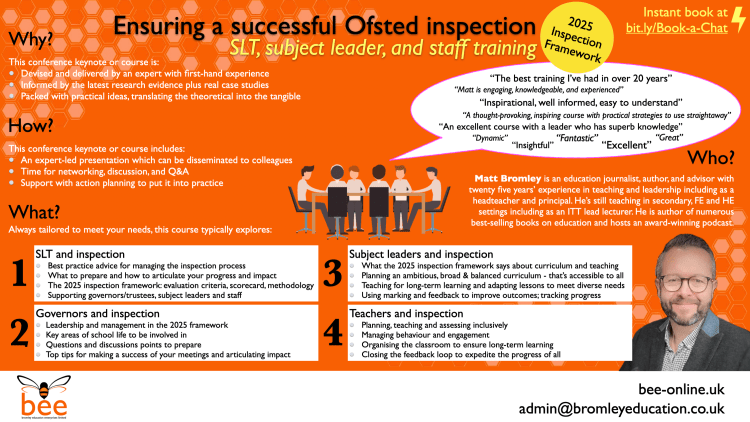
Here’s what colleagues who’ve recently attended Matt’s inspection training have had to say…
“Informative and knowledgeable leader who was both engaging and insightful.”
“Excellent!”
“Very useful – it got us to drill down and reflect on our own practice.”
“Very informative with clear strategic ideas.”
“A very welcome overview of the process.”
“Really informative – it’s made me feel a lot clearer as a new Headteacher of what I need to do to prepare for OFSTED.”
“Very helpful and covered all the main areas.”
“Very thorough and the presenter was engaging.”
“Very informative and thought provoking.”
“Really informative, well-paced, and gave me the information I needed.”
 bee | Bromley Education Enterprises Limited