

In the third of six articles originally published in SecEd Magazine, Matt Bromley analyses Ofsted’s new evaluation areas. In this article, he explores achievement…
Ofsted’s new inspection framework has been unveiled and will be introduced from 10 November.
I have written previously about the key aspects of the framework and I have set out some initial actions that school leaders might consider.
I am now, in this series, exploring the six core evaluation areas that schools are to be judged upon in the new report cards.
If you haven’t already read the first two parts, you can catch up here:
A caveat: Please do not interpret my advice as constituting a checklist; rather, it is a sense-check, a way of helping you start a conversation with colleagues about your daily practice and your evidence base. Use your professional judgement throughout: take away anything you think will be helpful but ignore anything that doesn’t fit your context or approach.
In this, part three of my series, I will be focusing on achievement.
Key questions
At its most basic, inspectors are looking to answer three questions about achievement:
- Does the school provide a high-quality education for all pupils, especially disadvantaged pupils, those with SEND, those who are known (or previously known) to children’s social care, and those who may face other barriers to learning or wellbeing, that gives them the necessary knowledge, skills and qualifications to succeed, and equips them for the next stage of their education, training or employment?
- How does pupils’ attainment and progress over time in national tests and examinations compare?
- What progress do pupils make across the curriculum from their starting points? Do they know more, remember more, and are they able to do more?
Inspectors will focus on gathering evidence relating to the following factors:
- Securing important foundational knowledge in language and communication, reading, writing and mathematics so that pupils can access the whole curriculum.
- Reading fluently at an age-appropriate level.
- Securing the knowledge and skills pupils need before undertaking more complex tasks.
- Ensuring that pupils make progress from their starting points, in that they know more, remember more and can do more; they learn what is intended, and develop broad and deep subject knowledge across the curriculum.
- Equipping pupils to produce high-quality work that reflects the breadth and depth of their learning.
- Equipping pupils to achieve well in national tests and examinations, where relevant, and across the wider curriculum.
- Preparing pupils, at each phase, for the next stage of education, training or employment.
So, what might this look like in practice? Let’s explore each factor in turn.
1, Securing foundational knowledge in language, communication, reading, writing and mathematics
What it might look like in practice:
- Strong focus where pupils have low starting points on oracy, phonics, number sense, handwriting.
- Daily opportunities for talk, structured vocabulary development and guided reading.
- Maths fluency practices embedded (e.g. number bonds, multiplication facts).
Actions to take:
- Ensure progression documents map-out key foundational skills explicitly.
- Build-in retrieval practice and fluency checks.
- Monitor the impact of phonics and early maths interventions.
How to prepare:
- Evidence file: Progression maps, phonics outcomes, assessment data.
- Lesson visits: Show pupils applying core skills across the curriculum.
- Be ready to articulate how leaders prioritise “keeping up not catching up”.
2, Reading fluently at an age-appropriate level
What it might look like in practice:
- All pupils read daily, with regular fluency checks.
- Catch-up interventions are immediate for those falling behind.
- Reading culture: Libraries, displays, staff modelling reading.
Actions to take:
- Invest in high-quality texts, decodable for early readers and challenging for older ones.
- Regularly assess fluency, not just comprehension.
- Track reading age against chronological age.
How to prepare:
- Evidence file: Reading age data, intervention logs, pupil voice surveys.
- Lesson visits: Guided reading, one-to-one fluency checks.
- Be able to explain leaders’ strategy for tackling the bottom 20%.
3, Securing knowledge and skills before tackling complex tasks
What it might look like in practice:
- Scaffolding is in place to ensure mastery of prerequisite knowledge.
- Teachers explicitly revisit prior learning before moving on.
- Assessments are used to check readiness for progression.
Actions to take:
- Develop “readiness-to-learn” checklists for key topics.
- Train staff in scaffolding and diagnostic assessment.
- Embed low-stakes quizzes to check prior knowledge.
How to prepare:
- Evidence file: Curriculum maps showing sequencing and scaffolds.
- Lesson visits: Look for pre-teaching and consolidation before new content.
- Be ready to articulate how leaders prevent cognitive overload.
4, Pupils making progress from their starting points
What it might look like in practice:
- Pupils can articulate what they have learned and retained.
- Leaders track progress by cohorts, groups, and individuals.
- Pupils are challenged appropriately and expectations are not lowered.
Actions to take:
- Use baseline assessments in EYFS and year 7 to track from starting points.
- Ensure regular review meetings (e.g. pupil progress meetings).
- Share exemplar pupil work showing growth over time.
How to prepare:
- Evidence file: Progress data, work scrutiny samples, case studies of vulnerable pupils.
- Lesson visits: Pupils demonstrate knowledge recall and application.
- Leaders should be ready to explain what “progress” looks like beyond test scores.
5, Producing high-quality work reflecting breadth and depth
What it might look like in practice:
- Pupil books show extended writing, problem-solving, creative outcomes.
- Consistency across subjects in presentation and expectations.
- Cross-curricular projects show knowledge transfer.
Actions to take:
- Moderate work regularly within and across year groups.
- Train staff to set tasks that elicit depth, not surface recall.
- Showcase high-quality pupil work in displays and exhibitions.
How to prepare:
- Evidence file: Moderated work samples, displays, subject leader reports.
- Lesson visits: Look for pupils producing work that demonstrates real depth.
- Be ready to show how high standards are consistently expected for all groups.
6, Achieving well in national tests and across wider curriculum
What it might look like in practice:
- Pupils perform at or above national averages in tests.
- Wider curriculum achievements – music, sport, arts, competitions.
- Targeted interventions for disadvantaged/SEND pupils with visible outcomes.
Actions to take:
- Use assessment data to target intervention without narrowing the curriculum.
- Celebrate and record wider achievements as rigorously as test results.
- Support staff with test preparation strategies that build confidence, not anxiety.
How to prepare:
- Evidence file: National test data, wider enrichment logs, participation records.
- Lesson visits: Pupils applying knowledge in test-style tasks and wider settings.
- Leaders should be ready to explain how curriculum breadth is protected.
7, Preparing pupils for the next stage of education, training or employment
What it might look like in practice:
- Clear progression pathways through each phase.
- Pupils leave with academic qualifications and life-skills.
- Careers education is embedded.
Actions to take:
- Build strong transition programmes between key stages.
- Ensure careers education is sequenced and monitored.
- Gather feedback from alumni and destination data.
How to prepare:
- Evidence file: Transition plans, careers curriculum, destination data.
- Lesson visits: Pupils articulating aspirations and next steps.
- Be ready to show inspectors how the school’s curriculum opens doors for every pupil.
Taking account of context
When considering the factors above, inspectors should take account of how they apply to different ages and stages of learning, and the needs of different groups of pupils. Here’s what the inspection toolkit (Ofsted, 2025) says.
In schools where published data from national tests and examinations is available, inspectors will consider the following:
- What the published data indicates about achievement over time and use this as a starting point for discussions with leaders about achievement.
- How comprehensive the picture presented by published outcomes is (for example, what proportion of pupils or subjects the data is available for). Inspectors should be aware of the data’s gaps or limitations, for example in relation to small cohorts; inspectors should take into account that published outcomes do not reflect the achievement of pupils in every year group, or of some groups, such as some pupils with SEND.
- How compelling the picture presented by published outcomes is (for example, the consistency of outcomes over time and whether performance is in line with, exceeds or falls below national averages).
- Evidence gathered on site to provide a fuller picture of achievement over time, particularly for groups of pupils or phases for which published data is not available.
- What published data, set alongside evidence gathered on site, indicates about pupils’ achievement over time.
Inspectors should not review internal data. However, they may discuss with leaders how they use internal assessment data, what it tells them about pupils’ achievement, and what decisions they make as a result.
When published data from national tests and examinations is not available, for example for some year groups, key stages or groups of pupils, including some pupils with SEND, inspectors should consider evidence gathered on site to provide a picture of pupils’ achievement over time.
This includes evidence from learning walks, pupils’ work, discussions with pupils and case sampling. They take particular care in gathering evidence on the progress over time of disadvantaged pupils, those with SEND, those who are known (or previously known) to children’s social care, and those who may face other barriers to their learning and/or wellbeing.
Different phase and setting considerations
Secondary
Inspectors will consider:
- Whether pupils achieve well in national tests and examinations, where relevant.
- The extent to which pupils make progress across the whole curriculum and through key stage 3, in preparation for key stage 4 and post-16 study.
- The extent to which gaps in knowledge are tackled for pupils who are at the early stages of securing their foundational knowledge (including reading fluency), so that they can access the wider curriculum.
Nursery and early years
When inspectors evaluate achievement in maintained nursery schools and schools with early years provision, they should consider how quickly and securely children develop the necessary foundational knowledge to access later learning. This includes how they are supported to make the best possible start, and how children who might fall behind are supported to keep up so that all pupils can progress in their learning.
Primary schools
When inspectors evaluate achievement in schools with primary-age pupils, they will consider:
- How quickly and securely pupils develop a strong foundation in communication and language, reading, writing and mathematics; this includes how the youngest pupils are supported to make the best possible start, and how pupils who might fall behind are supported to keep up, so that all pupils can access the curriculum and progress in their learning.
- Whether pupils achieve well in national tests, where relevant.
- The extent to which pupils in key stage 2 have developed the knowledge and skills across the wider curriculum to prepare them for later study. Inspectors bear in mind that for younger pupils and those at an earlier stage of developing their foundational knowledge, the school’s priority must be to secure the foundations that will support access to the wider curriculum and later learning.
When inspectors evaluate achievement in small schools, they should bear in mind that published data for small cohorts is likely to fluctuate considerably.
SEND provision
When inspectors evaluate the achievement of pupils with SEND, they will:
- Keep in mind that published outcomes data may not give a sufficiently detailed picture of the progress and achievement of some groups of pupils, or this data might not be available, and therefore evidence gathered on site is crucial to evaluating progress and achievement.
- Consider pupils’ starting points and the progress they make from them; inspectors also want to understand the curriculum pathways of individuals or groups, and whether leaders have identified the right priorities for them and are ensuring that they make good progress.
Next time: I will explore attendance and behaviour.
I hope you found that useful. Get in touch if you have questions.
If you want more help, check out the book…

This book is a repost to the snake oil salesmen who’ll tell you what to do to impress inspectors. Don’t be fooled by the title – the subtitle is doing the heavy-lifting. It’s about doing what’s right for your pupils every day, not what’s right for inspectors during their two-day visit. Yes, it unpacks the new framework in a way that makes sense to busy school leaders and teachers, and yes it offers loads of practical tools that will help you evidence what you do, but the advice and resources you”ll find in this book are about the long-haul of genuine and sustainable school improvement, not quick fixes. If in doubt, read a sample of the book, you might be pleasantly surprised!
And consider booking Matt to deliver training in your school…
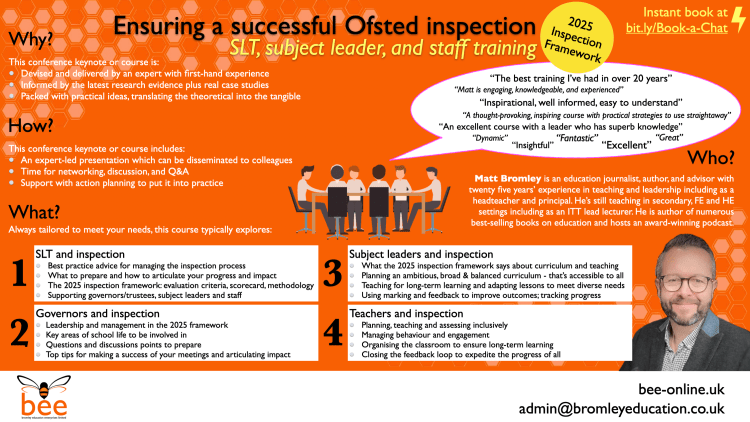
Here’s what colleagues who’ve recently attended Matt’s inspection training have had to say…
“Informative and knowledgeable leader who was both engaging and insightful.”
“Excellent!”
“Very useful – it got us to drill down and reflect on our own practice.”
“Very informative with clear strategic ideas.”
“A very welcome overview of the process.”
“Really informative – it’s made me feel a lot clearer as a new Headteacher of what I need to do to prepare for OFSTED.”
“Very helpful and covered all the main areas.”
“Very thorough and the presenter was engaging.”
“Very informative and thought provoking.”
“Really informative, well-paced, and gave me the information I needed.”
 bee | Bromley Education Enterprises Limited