

In the second of six articles originally published in SecEd Magazine, Matt Bromley analyses Ofsted’s new evaluation areas. In this article, he explores curriculum and teaching…
Ofsted’s new inspection framework has been unveiled and will be introduced from November. In this series, I am exploring the six core evaluation areas that schools are to be judged upon in the new report cards.
As I said last time, please do not interpret my advice as constituting a checklist; rather, it is a sense-check, a way of helping you start a conversation with colleagues about daily practice and your evidence-base. Use your professional judgement throughout: take away anything you think will be helpful, but ignore anything that doesn’t fit your context.
In this, part 2 of our series, I will be focusing on curriculum and teaching.
Key questions
At its most basic, inspectors are looking to answer three questions about your school’s curriculum and teaching.
- Do leaders design a high-quality, ambitious curriculum for all pupils, paying particular regard to disadvantaged pupils, those with SEND, those who are known (or previously known) to children’s social care, and those who may face other barriers to their learning and/or wellbeing?
- Do leaders and staff deliver the curriculum effectively across all subjects, year groups and key stages?
- Do leaders make sure that pupils build strong foundations for accessing the curriculum and for later success, including academic achievement, good health and wellbeing?
Inspectors will focus on gathering evidence relating to the following factors:
- Constructing, adopting or adapting a curriculum that is ambitious, broad and balanced, informed by the best available evidence, and designed to give all learners, especially the groups of pupils listed above, the knowledge they need to achieve and thrive in later life.
- Planning and sequencing the curriculum clearly so that all pupils can access it and gain knowledge and skills incrementally to reach its stated aims.
- Establishing strong foundations in communication and language, reading, writing and mathematics so that pupils can access the rest of the curriculum and gain later success, including academic achievement, good health and wellbeing.
- Making sure that teachers have expert knowledge of the national curriculum, the Early Years Foundation Stage (EYFS) and 16 to 19 study programmes as appropriate, and the subjects/phases they teach.
- Making sure the curriculum is implemented in line with leaders’ intentions and that teachers teach the subject curriculum effectively, focusing on the most important knowledge or concepts, presenting information clearly, checking pupils’ understanding systematically, and adapting their teaching appropriately.
- Using assessment effectively to inform teaching and learning, and to help pupils embed key concepts, use knowledge fluently, and develop their understanding.
So, what might this look like in practice? Let’s explore each factor in turn…
1, Ambitious, broad and balanced curriculum
What it might look like in practice:
- Curriculum designed to give all pupils, including disadvantaged, SEND, and children in care, the knowledge and cultural capital they need.
- A broad range of subjects beyond English and maths, including sciences, humanities, arts, and vocational opportunities.
- Curriculum informed by evidence (Education Endowment Foundation, curriculum research, best practice from other schools).
Actions to take:
- A curriculum audit to ensure breadth, coherence, and inclusivity.
- Document how curriculum choices reflect the needs of vulnerable groups.
- Engage subject leaders in curriculum design using research evidence.
How to prepare:
- Prepare a curriculum intent statement, showing rationale and ambitions for all pupils.
- Have examples of curriculum adaptations for disadvantaged or SEND pupils.
2, Clear planning and sequencing
What it might look like in practice:
- Knowledge and skills sequenced progressively across topics, years, and key stages.
- Topics build logically on prior learning, ensuring pupils master foundational knowledge before advancing.
- Curriculum maps and medium-term plans showing progression and connections across subjects.
Actions to take:
- Review schemes of work and medium-term plans to check progression.
- Use knowledge organisers and topic overviews to ensure coherent sequencing.
- Align curriculum sequencing with assessment check-points.
How to prepare:
- Have curriculum maps and examples of lessons showing incremental skill and knowledge development.
- Be able to explain how sequencing supports pupils with gaps in prior learning.
3, Strong foundations in literacy and numeracy
What it might look like in practice:
- Early language development, phonics, reading, and writing skills within EYFS and key stage 1 as well as for those with low starting points in secondary.
- Mathematics progression supports problem-solving and reasoning, not just calculation.
- Literacy and numeracy skills explicitly linked to other subjects (e.g. reading in history, maths in science).
Actions to take:
- Prioritise early intervention for pupils struggling with reading or maths.
- Ensure phonics teaching is consistent and systematic.
- Train teachers to spot gaps in literacy/numeracy and provide targeted support.
How to prepare:
- Keep assessment data showing literacy/numeracy progress.
- Have examples of interventions supporting pupils to access wider curriculum.
4, Teachers’ expert knowledge
What it might look like in practice:
- Teachers understand the national curriculum for the key stage before and after that which they teach, as well as their own, and are confident in their subjects.
- Teachers can explain and teach key concepts clearly and sequentially.
- Teachers are aware of common misconceptions and plan to address them.
Actions to take:
- Provide subject-specific CPD and coaching.
- Facilitate subject leader networks to share expertise.
- Observe teaching with a focus on subject knowledge use.
How to prepare:
- Keep CPD records linked to subject expertise.
- Be able to provide examples of teachers demonstrating strong subject knowledge in lessons.
5, Implementation in line with intent
What it might look like in practice:
- Lessons reflect the intended curriculum; teachers focus on the most important knowledge.
- Teachers check understanding through questioning, live feedback, and formative assessment.
- Teaching adapts to pupils’ needs, including scaffolded support or enrichment for higher-attaining pupils
Actions to take:
- Conduct learning walks and book-looks to ensure fidelity to curriculum intent.
- Provide coaching/feedback for teachers where delivery does not align.
- Ensure resources support effective implementation.
How to prepare:
- Gather lesson observation evidence demonstrating curriculum intent delivered effectively.
- Be ready to discuss adaptations made for different pupil groups.
6, Assessment to inform teaching and learning
What it might look like in practice:
- Assessment identifies gaps in knowledge, fluency, and understanding.
- Teachers use assessment to plan subsequent lessons, reteach concepts, or provide enrichment.
- Pupils can demonstrate cumulative knowledge and use it fluently across contexts.
Actions to take:
- Develop a clear assessment framework aligned with curriculum goals.
- Train staff to use formative assessment effectively.
- Review assessment data termly to inform interventions and curriculum adjustments.
How to prepare:
- Keep records of assessment use to identify and address gaps.
- Have examples of adjustments made following assessment to improve outcomes.
Inclusive curriculum and teaching
When inspectors evaluate the curriculum and teaching for pupils with SEND, they will:
- Seek to understand the starting points of pupils with SEND.
- Consider whether pupils have access to a suitable curriculum that builds on their knowledge and is adapted to their needs.
- Recognise that pupils’ work can take many forms and discuss this with leaders.
- Consider whether pupils’ needs are properly considered and are met through the design and delivery of the curriculum, including taking into account any reasonable adjustments that need to be made.
- Work closely with leaders and staff to understand their strategies to help pupils communicate and, where appropriate, use these strategies (with support from staff) to gather first-hand evidence.
Let’s have a look at what this might mean in practice…
1, Inspectors will seek to understand the starting points of pupils with SEND
What leaders and teachers could do:
- Establish clear baseline assessments (academic, social, emotional, communication, sensory, physical).
- Use prior attainment, EHCP outcomes, Personal Education Plans (PEPs) if applicable, and teacher observations.
- Track progress from those baselines rather than only against age-related expectations.
What this might look like in practice:
- Class teachers can explain the starting points of their pupils with SEND.
- SENCOs keep records showing initial assessments and how provision has been tailored from that point.
- Learning walks and case studies evidence how starting points inform planning.
2, Inspectors will consider whether pupils have access to a suitable curriculum that builds on their knowledge and is adapted to their needs
What leaders and teachers could do:
- Ensure curriculum is not narrowed unnecessarily for SEND pupils; adaptations should enable, not replace, access.
- Scaffold tasks, pre-teach vocabulary, provide alternative formats (visuals, concrete materials, digital support).
- Ensure progression pathways are clear, even if steps are smaller.
What this might look like in practice:
- Pupils with SEND work alongside peers where possible, with targeted support.
- Adaptations are evident in lesson planning and delivery, not just in paperwork.
- Leaders can show how curriculum pathways (e.g. phonics/early reading, life-skills, vocational learning) are ambitious and tailored.
3, Inspectors will recognise that pupils’ work can take many forms
What leaders and teachers could do:
- Value a wide range of evidence: oral contributions, photographs of practical work, digital portfolios, structured play outcomes, sensory responses.
- Train staff to record and celebrate progress beyond written work.
- Build consistency in how evidence is gathered and shared across the school.
What this might look like in practice:
- Teachers have annotated photos or short observations in books/portfolios.
- Pupils can show their understanding verbally or through practical application.
- Inspectors will see progression in multiple forms — not just exercise books.
4, Inspectors will consider whether pupils’ needs are properly considered and are met through the design and delivery of the curriculum, including reasonable adjustments
What leaders and teachers could do:
- Use the graduated approach (assess, plan, do, review) consistently.
- Apply reasonable adjustments (e.g. extra time, assistive technology, adapted resources, classroom layout).
- Monitor effectiveness of adjustments and adapt regularly.
What this might look like in practice:
- Teachers can explain how they differentiate tasks or adapt approaches for specific pupils.
- Seating plans and classroom organisation show consideration of individual needs.
- Evidence of impact: improved engagement, reduced barriers, progress against individual targets.
5, Inspectors will work closely with leaders and staff to understand strategies to help pupils communicate, and may use these strategies themselves
What leaders and teachers could do:
- Provide consistent communication systems across the school (e.g. Makaton, PECs, communication boards, AAC devices).
- Train staff to use communication approaches confidently.
- Ensure inspectors can access these systems quickly (leaders should demonstrate them).
What this might look like in practice:
- Inspectors may use a pupil’s communication aid (with staff guidance) to talk to them.
- Teachers model communication strategies during lessons.
- Leaders brief inspectors on what strategies are used, why, and how they support curriculum access.
Some further top tips
- Case studies: Have 2 or 3 strong case studies ready to illustrate how the school identifies starting points, adapts curriculum, and tracks progress for pupils with SEND.
- Staff voice: Make sure teachers (not just the SENCO) can articulate what adaptations they make and why.
- Pupil voice: Be ready to show how pupils themselves experience the curriculum – using communication systems if needed.
- Evidence file: Pull together examples of different forms of work (photos, portfolios, assessment records) to demonstrate progress.
- SEND walkthroughs: Practise explaining to inspectors how curriculum intent and implementation reflect the needs of SEND pupils in your context.
Next time I will explore ‘achievement’.
I hope you found that useful. Get in touch if you have questions.
If you want more help, check out the book…

This book is a repost to the snake oil salesmen who’ll tell you what to do to impress inspectors. Don’t be fooled by the title – the subtitle is doing the heavy-lifting. It’s about doing what’s right for your pupils every day, not what’s right for inspectors during their two-day visit. Yes, it unpacks the new framework in a way that makes sense to busy school leaders and teachers, and yes it offers loads of practical tools that will help you evidence what you do, but the advice and resources you”ll find in this book are about the long-haul of genuine and sustainable school improvement, not quick fixes. If in doubt, read a sample of the book, you might be pleasantly surprised!
And consider booking Matt to deliver training in your school…
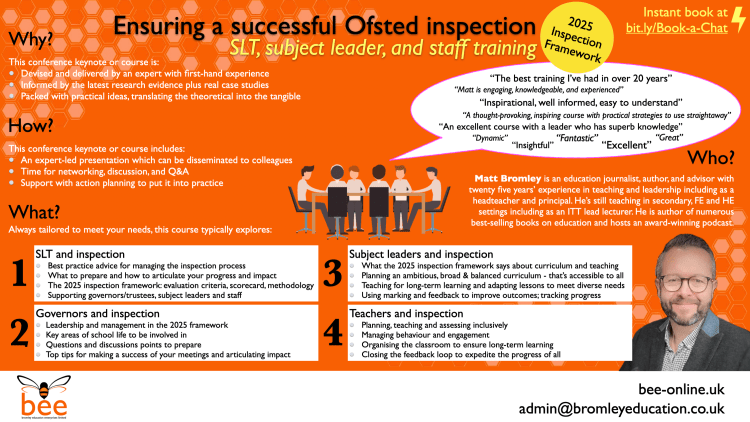
Here’s what colleagues who’ve recently attended Matt’s inspection training have had to say…
“Informative and knowledgeable leader who was both engaging and insightful.”
“Excellent!”
“Very useful – it got us to drill down and reflect on our own practice.”
“Very informative with clear strategic ideas.”
“A very welcome overview of the process.”
“Really informative – it’s made me feel a lot clearer as a new Headteacher of what I need to do to prepare for OFSTED.”
“Very helpful and covered all the main areas.”
“Very thorough and the presenter was engaging.”
“Very informative and thought provoking.”
“Really informative, well-paced, and gave me the information I needed.”
 bee | Bromley Education Enterprises Limited