

In the first of six articles originally published in SecEd Magazine, Matt Bromley analyses Ofsted’s new evaluation areas, starting with inclusion…
Here’s a caveat before I begin: do not interpret my advice as constituting a checklist; rather, it is a sense-check, a way of helping you start a conversation with colleagues about your daily practice and your evidence base.
Use your professional judgment throughout: take away anything you think will be helpful, including the confidence you’re already doing everything I suggest and more, but ignore anything that doesn’t fit your context or approach.
And remember: We don’t do it for Ofsted. As educators, we do what we do for the children and communities we serve. And if we do what’s in their best interests and act with integrity at all times, then we should have nothing to fear from Ofsted.
The golden thread
Ofsted have made inclusion both a specific evaluation area and a key theme across other evaluation areas. From leadership to teaching to behaviour, all aspects of education provision should support children and learners who are disadvantaged, those who have SEND, and those are known to children’s social care.
As such, inspectors will evaluate whether schools are identifying and offering high-quality support for all children and learners. This will include how schools are using targeted funding (such as the pupil premium or high-needs funding).
Define disadvantage
It is not for Ofsted to define disadvantage. In the documentation, they refer to those children and learners who are disadvantaged, those with SEND, and those who are known to children’s social care. And they say they’ll always consider where those with protected characteristics are negatively impacted by barriers in a provider’s context.
But this need not be your definition. Indeed, I would suggest – as a starting point – that you agree a shared definition for your school. In so doing, I would encourage you to look beyond the funding formula because that is not a perfect science. Take, for example, the pupil premium which targets funding at pupils claiming free school meals, those who are or have previously been looked after by a local authority, and the children of service families. But this is a narrow definition of disadvantage that excludes many of our most impoverished and ‘at risk’ children.
Your school’s shared definition will be central to your argument about your context and how you’re supporting disadvantaged pupils and closing the attainment gap between your disadvantaged pupils and their peers. So, let’s do a deeper dive on it…
The pupil premium is flawed on the following grounds:
Firstly, free school meals are only available to families on certain income-related benefits. Low-income families who fall just above the threshold, or those with insecure work patterns, may experience significant financial hardship but are not entitled to FSM.
Secondly, some families who are eligible do not apply for FSM due to stigma, lack of awareness, language barriers, or difficulties navigating the application process. This under-registration reduces the number of children attracting funding.
Thirdly, children from families with “No Recourse to Public Funds” (NRPF) are often not eligible for FSM, even though many live in deep poverty. This group is therefore systematically excluded from pupil premium support.
Finally, FSM eligibility reflects a “snapshot” of income linked to benefits at a given point in time. It may not capture families experiencing temporary but acute financial crises, or those whose circumstances fluctuate.
And the situation has worsened recently because, although the government has expanded FSM entitlement to all families receiving Universal Credit, which they claim will benefit 1.7 million children in Years 3 to 11, the change is not being extended to pupil premium funding nor home-to-school transport extended rights, funding which will continue to be “based on the existing FSMs threshold”.
As a consequence, many disadvantaged pupils are “invisible” to the system, meaning schools do not receive the resources intended to support them. Schools serving areas with widespread hidden poverty may have high need but relatively low PP allocations. Universal FSM policies have reduced the incentive for parents to apply for means-tested FSM, further weakening the link between disadvantage and PP funding.
In short: the pupil premium fails to capture many of the most disadvantaged children because it relies on an imperfect proxy for poverty. And thus, schools need to look beyond the funding to identify those children most in need of additional support in their context.
Here’s one approach school leaders could take to more accurately identify the most disadvantaged children in their setting. Instead of relying solely on funding, they could build a multi-criterion “vulnerability profile” of pupils, drawing on different data sources. These sources could include:
1. Measures of economic hardship, such as:
- FSM eligibility (means-tested, “Ever 6” FSM)
- Families with No Recourse to Public Funds (NRPF) or ineligible for FSM despite low income
- Pupil Premium eligibility gaps (children not registered for FSM but known to be struggling)
- Household income banding (where available via local authority data)
- Eligibility for local hardship grants / discretionary housing payments
2. Family and home circumstances, such as:
- Looked After Children (LAC) and previously looked after (PLAC)
- Young carers
- Children subject to a Child Protection Plan or Child in Need Plan
- Children living in temporary accommodation or known housing insecurity
- Families using food banks or referred to early help/social services
- Parental factors: long-term unemployment, substance misuse, imprisonment, domestic abuse
3. Educational indicators, such as:
- Persistent absence or lateness (often linked to socio-economic stress)
- Low prior attainment or delayed language development
- Limited access to digital devices or internet at home
- Special Educational Needs and Disabilities (SEND) without adequate family resources
4. Contextual deprivation, such as:
- Indices of Multiple Deprivation (IMD): linking pupil postcodes to local area deprivation scores
- Neighbourhood free school meal take-up rates (school-level benchmarking)
- Rural/isolated households with limited access to services
In practice, you might then…
Gather data from: school records including FSM registration, attendance, attainment, SEND status, safeguarding logs; local authority data including children’s services, housing, NRPF teams, discretionary funding records; national datasets including IDACI (Income Deprivation Affecting Children Index) linked to pupil postcodes and IMD rankings for local areas; community intelligence including food bank referrals, voluntary sector partners, early help services; and parent/carer surveys including self-reported barriers (digital poverty, childcare costs, food insecurity).
Use this data to: create a “disadvantage dashboard” combining multiple indicators; develop a tiered support model (e.g. FSM+PP pupils, wider economic hardship pupils, vulnerable context pupils); and direct interventions (academic tutoring, pastoral care, wellbeing support) more accurately than FSM alone.
You are helped in that the pupil premium is flexible funding. Whilst you must monitor and evaluate the impact of pupil premium spend on eligible pupils, and report on this in your strategy for auditing purposes, your school’s spending is not limited to eligible pupils. Indeed, you can use the funding in any way you wish, so long as it’s evidence-informed and you can justify it. I would suggest you identify your disadvantaged cohort in your strategy and also monitor and evaluate the impact of your actions on this broader group.
What inspectors are looking for under ‘inclusion’
Returning to Ofsted, the toolkit says that inspectors will focus on gathering evidence of inclusion relating to the following factors:
- setting high expectations for all pupils, including disadvantaged pupils, those with SEND, those who are known (or previously known) to children’s social care, and those who may face other barriers to their learning and/or well-being
- embedding a culture in which early and accurate assessment of pupils’ needs is prioritised
- using the information from the assessment of pupils’ needs to implement a continuous cycle of planning, actions and review in order to reduce barriers to pupils’ learning and/or well-being
- involving specialists when necessary to support pupils’ development
- putting in place a pupil premium strategy that is well thought through, is based on evidence of what works well to support the achievement of eligible pupils, and accounts for any challenges pupils face that may negatively affect their education and their readiness to engage with school
- working closely and effectively with pupils, parents, professionals and staff, and ensuring that pupils’ and parents’ views and aspirations are included in decision-making about support for pupils
So, what might this look like in practice? Let’s explore each factor in turn…
1. Setting high expectations
In practice this might look like:
- Articulating a clear curriculum ambition for every child (e.g. all pupils study the full breadth of subjects unless there is a clear evidence-based reason otherwise)
- Ensuring all teachers use scaffolding rather than lowering the bar (e.g. visual prompts, sentence starters, pre-teaching key vocabulary)
- Applying behaviour and attendance expectations consistently, with appropriate support for those who struggle
How to prepare:
- Review curriculum pathways: ensure no group is disproportionately excluded from subjects
- Gather evidence of how staff adapt teaching (not “dumbing down”) to ensure access
- Train staff to challenge unconscious bias and deficit thinking
2. Embedding a culture of early and accurate assessment
In practice this might look like:
- Conducting baseline assessments (academic, speech/language, social/emotional) when pupils join
- Using systematic screening tools (phonics checks, reading age tests, attendance/behaviour trackers)
- Training staff to spot early warning signs of need (speech delay, trauma indicators, hidden disadvantage)
How to prepare:
- Map assessment processes across phases: what is checked, when, and how information is recorded
- Provide CPD for teachers and support staff on noticing early indicators
- Ensure SENDCo and pastoral teams regularly share insights with teaching staff
3. Using assessment information in a continuous cycle
In practice this might look like:
- Making individual pupil support plans live documents (updated regularly, not filed away)
- Conducting termly reviews of interventions (e.g. literacy catch-up, mentoring) with data showing impact
- Ensuring leaders stop ineffective strategies and replace them with stronger approaches
How to prepare:
- Audit current interventions: which ones are evidence-based (e.g. EEF Toolkit)?
- Build systems for reviewing progress (meetings, pupil progress boards, dashboards)
- Keep case studies of pupils showing how the cycle has worked to reduce barriers
4. Involving specialists when necessary
In practice this might look like:
- Putting in place swift referral pathways to external professionals (educational psychologists, CAMHS, speech & language therapists, youth workers)
- Scheduling joint planning meetings with specialists and school staff
- Ensuring staff act on specialist recommendations consistently in the classroom
How to prepare:
- Keep logs of referrals and follow-ups
- Train staff to interpret and implement specialist advice
- Build relationships with local agencies and keep evidence of collaborative working
5. Pupil Premium strategy
In practice this might look like:
- Publishing your PP strategy on the school website showing links to EEF evidence, but tailored to local challenges (e.g. high mobility, NRPF families, digital poverty)
- Allocating funding to both academic and pastoral barriers (e.g. tutoring, but also breakfast clubs and attendance support)
- Ensuring leaders can explain why certain decisions were made and what outcomes are being tracked
How to prepare:
- Write a clear PP statement (3-year plan with annual review) that goes beyond FSM tick-boxes
- Monitor and evaluate impact: show data, but also pupil voice and case studies
- Ensure governors/trustees are engaged and can articulate the rationale
6. Working closely with pupils, parents, professionals, and staff
In practice this might look like:
- Holding regular structured conversations with parents of disadvantaged/SEND pupils (not just at parents’ evenings)
- Ensuring pupil voice forums feed into decisions about curriculum, well-being, and provision
- Scheduling multidisciplinary meetings where staff, parents, and professionals co-create plans
How to prepare:
- Set up systems for recording pupil and parent feedback and how it has been acted upon
- Train staff in relational practice and effective communication with families
- Develop examples of co-produced plans (e.g. Education, Health & Care Plans, pastoral support plans)
Pupils not policies
Note that Ofsted will want to see not only policies and strategies but also the lived experience of pupils. As such, you should be ready to:
- Provide case studies of individual pupils (anonymised) showing how barriers were identified and reduced.
- Show evidence that inclusion is everyone’s responsibility, not just the SENDCo or PP lead.
- Demonstrate impact with both data (attendance, attainment, progress) and stories (pupil/parent voice).
When considering the factors above, inspectors will take account of how they apply to different ages and stages of learning, and the needs of different groups of pupils. So be ready to talk about your context and show an understanding of the community you serve and of the pupils on your roll.
Next time I will explore ‘curriculum and teaching’.
I hope you found that useful. Get in touch if you have questions.
If you want more help, check out the book…

This book is a repost to the snake oil salesmen who’ll tell you what to do to impress inspectors. Don’t be fooled by the title – the subtitle is doing the heavy-lifting. It’s about doing what’s right for your pupils every day, not what’s right for inspectors during their two-day visit. Yes, it unpacks the new framework in a way that makes sense to busy school leaders and teachers, and yes it offers loads of practical tools that will help you evidence what you do, but the advice and resources you”ll find in this book are about the long-haul of genuine and sustainable school improvement, not quick fixes. If in doubt, read a sample of the book, you might be pleasantly surprised!
And consider booking Matt to deliver training in your school…
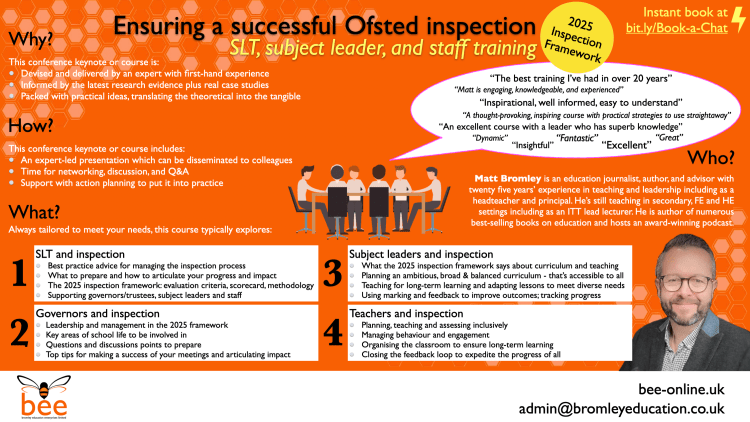
Here’s what colleagues who’ve recently attended Matt’s inspection training have had to say…
“Informative and knowledgeable leader who was both engaging and insightful.”
“Excellent!”
“Very useful – it got us to drill down and reflect on our own practice.”
“Very informative with clear strategic ideas.”
“A very welcome overview of the process.”
“Really informative – it’s made me feel a lot clearer as a new Headteacher of what I need to do to prepare for OFSTED.”
“Very helpful and covered all the main areas.”
“Very thorough and the presenter was engaging.”
“Very informative and thought provoking.”
“Really informative, well-paced, and gave me the information I needed.”
 bee | Bromley Education Enterprises Limited