

Winston Churchill is purported to have said that “Democracy is the worst form of government except for all those other forms that have been tried”. The same might be said of Ofsted – the Office for Standards in Education, a government quango that inspects state-funded schools in England.
Ofsted divide opinion. Either they’re a force for good, ensuring educational standards are improved, children are kept safe, and parents are able to make informed decisions about where to educate their children. Or they’re responsible for untold stress and suffering among school leaders and staff, putting hard-working educationalists through torture and ruining reputations.
I have my view, but I won’t share it here. I will say this, though: Ofsted are not perfect and nor is their latest inspection framework. But Ofsted exist and schools can’t escape their inspections.
As such, in my new book, How to Ace Ofsted, I focus on what schools can do to ensure an inspection is as pain-free as possible – and ends in success. Not by doing lots of things for the purposes of inspection, or by producing lots of documents solely for inspectors’ eyes. But by understanding the inspection process and developing a shared language so that all staff know what inspectors are looking for, and by ensuring that what they do every day is in the best interests of their children and communities.
My book is packed with practical tools and tangible tips – all of which constitute perennial good practice advice about how to make school improvement your routine not your rescue plan. In short, How to Ace Ofsted is a book, not about faking inspection readiness, but about making inspection-readiness your everyday reality.
Here is an extract from the book’s introduction as both an enticement to buy the book and as free advice to those schools expecting inspection…
We don’t do it for Ofsted
We don’t do it for Ofsted. As educators, we do what we do for the children and communities we serve. And if we do what’s in their best interests and act with integrity at all times, then we should have nothing to fear from Ofsted. So, my advice is simple: do what’s right for your children and communities and make that work within the inspection process.
When you get ‘the call’, don’t panic! Your school is amazing and so are you. Besides – and let me whisper this – even if it’s not quite where it needs to be yet, it’s too late to do anything about it by the time inspectors turn up at your door. So don’t try! If you attempt to make changes after you’ve had ‘the call’ then it will backfire. So, as I say, don’t panic.
It is what it is. Be honest, be confident, be you. And as a school leader, your colleagues are looking to you to model how to feel. You are their weathervane; you tell them which way the wind’s blowing. If you panic, so too will they. If you project apprehension, they’ll become nervous. So be the 3Cs: calm, collected, and confident. Even if that means you have to fake it before you make it.
Next, put wellbeing ahead of everything else. That means your pupils, your staff, and you! Take time to switch off. Stay fed and hydrated. Promote a healthy work-life balance, even the night before the inspection starts. No, especially the night before the inspection starts. Don’t commit to keeping the school open till midnight and encourage colleagues to stay late preparing – doing displays, marking books, writing lesson plans. All you’ll achieve is heightened stress levels and exhaustion. The best preparation is to go home at a reasonable hour and relax. Tell colleagues this is the expectation then model it: leave the car park early and your colleagues will follow.
The same rule applies during the two-day visit by Ofsted. Keep wellbeing top of the agenda. Walk the floor as often as possible, be visible. Check in with colleagues at lesson changeover and during social times. Smile. Reassure. Compliment. Tell your colleagues they’re amazing – you know it, their pupils know it. Soon, so too will inspectors.
Remember that inspectors don’t know your school as well as you do. They don’t walk those corridors every day, speak to children and their parents, work with your staff. As such, they are liable to make mistakes about your school. Don’t get frustrated by their errors of judgment or by the misconceptions they bring with them. Challenge inspectors. Diplomatically, politely, – but also firmly and robustly. And always with evidence.
And don’t just rely on dry data – stats have their uses, and I happen to love graphs, but they only show part of the picture. So, tell stories. Bring the data to life. Talk about the wonderful young people in your school – what they’re like, what they do and say, what they achieve, where they go next. Celebrate their successes. And not just their academic successes, either; but what they do beyond the curriculum and how they develop as people. And don’t just focus on the high-fliers, those to whom success seems to come easy. Talk about the children who face challenges and for whom success is an uphill struggle. Talk about how they overcome those challenges – with your help – and are determined to break the chains of their birth and define their own destinies.
In all you say, remember to focus on impact, impact, impact! What is the impact of your actions on the children and communities that you serve? Bring everything back to the ‘so what?’ – what does this mean for pupils and how does it help prepare them for future success?
Finally, rather than reinventing the wheel, adopt Ofsted’s three principles of inspection as your guiding star. Those principles are:
- Achieve
- Belong
- Thrive
Inspectors are told to hold these principles close to their hearts (I paraphrase) during inspection and thus you’d be wise to adopt them as part of your shared language.
In practice, ask:
- What do we do as a school to ensure that every pupil, regardless of background and need, is helped to achieve good academic outcomes and develop as a person so that they are prepared for the next stage of their journey? What do our outcomes look like in their broadest sense and do those with differences and disadvantages achieve in line with their peers?
- What do we do as a school to foster a sense of belonging for all, so that every pupil is seen and heard, and valued and respected? How do we ensure our school – its social and emotional environment, and its curriculum, teaching and assessment methods – reflects our pupils’ own lives and experiences? What impact does this have on pupil attendance, behaviour, and wellbeing?
- What do we do as a school to ensure every pupil can flourish? From policies and procedures, and systems and structures, to staff attitudes and daily actions, how do we create a culture in which children develop the knowledge and skills needed to be successful citizens of the world? Here, think about your personal development programme, extra-curricular activities, and careers education.
More top tips
Here are some more of my top tips for making a success of inspection…
- Remember Ofsted are not why we do what we do! Operate your normal school day and don’t panic! Preparation is not about rehearsing a performance; it’s about making your day-to-day reality inspection ready.
- Make quality assurance your routine, not your rescue plan. Maintain a rolling SEF that is updated termly with fresh evidence; avoid the “midnight before” rewrite. Link quantitative data, qualitative feedback (pupil/staff voice), and first-hand observation to tell a coherent story. Ensure every subject lead has a concise curriculum narrative, key data trends and how they’ve been addressed, and examples of pupil work showing progression over time
- Align your narrative to impact, not activity. Ofsted will be less interested in what you are doing, and more in what difference it makes. When discussing interventions, talk about impact on pupil learning rather than simply listing strategies. For wellbeing initiatives, show how they improve attendance, engagement, or wellbeing. In SEND provision, evidence closing gaps over time, not just the provision offered.
- Embed cultural readiness. Inspection readiness is as much about mindset as it is about paperwork. Think: can all staff articulate the school’s vision and core pedagogical principles in plain language? Can all staff explain their role in safeguarding, curriculum delivery, and pupil wellbeing? Can all pupils describe their learning, how they know they are making progress, and how the school supports them?
- Keep safeguarding inspection ready. Conduct termly safeguarding audits against the latest KCSIE and anticipated 2025 safeguarding guidance. Train all staff on emerging priorities (AI safety, gender-questioning student protocols, online harms). Ensure case records are accurate, timely, and securely stored – inspectors often look for consistency here as an indicator of culture.
- And above all… protect staff wellbeing before, during, and after an inspection. Avoid “mock inspections” that mimic stress without improving practice – opt for coaching-based reviews instead. Keep paperwork requirements proportionate; don’t generate “for Ofsted” documents that have no day-to-day value. Reassure staff that preparation is about showcasing reality, not performing perfection.
If inspection readiness is baked into your everyday systems, there’s no need to gear up when the call comes because the call won’t change what you do. The most confident schools are those where: Quality assurance is live, lean, and purposeful; everyone can tell the school’s story; and impact is clear, consistent, and compelling.
Talking of which…
Articulating impact
Here’s a useful rubric I’ve developed to help articulate to inspectors the impact of your actions since the last inspection. It will keep you focused and succinct.
Objective:
In order to… [e.g. improve the attendance of disadvantaged pupils]
Actions:
We did x, y, z… [detail the tangible steps taken: what, when, by whom]
Impact:
As a result of which, we… [use comparative data which shows the improvement not the outcome, e.g. the attendance of disadvantaged pupils improved from X% to Y% / by Z percentage points]
Evidence:
We know this because… [outline the data sources, aim for a weight of evidence which combines quantitative and qualitative data inc. staff/pupil voice]
Next:
Our next step is… [say what you’ll do now to further improve/sustain/embed your good practice]
Here it is in tabular form…
| Objective | Actions | Impact | Evidence | Next steps |
| In order to… | We… | As a result of which… | We know this because… | Our next step is… |
NOTE: This table, and countless more besides, is available to download from bit.ly/HowToAceOfsted… and they’re all FREE!
It would be helpful to have a line prepared for each of your areas for improvement from the last inspection and then to share it with all your staff so that everyone ‘sings from the same hymn sheet.’ In addition, I’d suggest you have a slimmed down version of your school improvement plan in which you articulate your top three strengths as a school and your top two areas for development. Again, share this with staff so everyone says the same things. For each aspect, explain:
- The strength
- How we know it’s a strength
- How we’re maintaining / embedding this good practice
- The weakness
- How we know it’s a weakness
- What we’ve already done to address it
- What more we plan to do
- Our intended outcome
Again, here it is in tabular form…
| Strengths | How we know | How we’re maintaining | Weaknesses | How we know | What we’ve done | What we plan to do |
| 1 | 1 | |||||
| 2 | 2 | |||||
| 3 |
I hope you found that useful… and, above all, reassuring. Get in touch if you have questions.
If you want more help, check out the book…

This book is a repost to the snake oil salesmen who’ll tell you what to do to impress inspectors. Don’t be fooled by the title – the subtitle is doing the heavy-lifting. It’s about doing what’s right for your pupils every day, not what’s right for inspectors during their two-day visit. Yes, it unpacks the new framework in a way that makes sense to busy school leaders and teachers, and yes it offers loads of practical tools that will help you evidence what you do, but the advice and resources you”ll find in this book are about the long-haul of genuine and sustainable school improvement, not quick fixes. If in doubt, read a sample of the book, you might be pleasantly surprised!
And consider booking Matt to deliver training in your school…
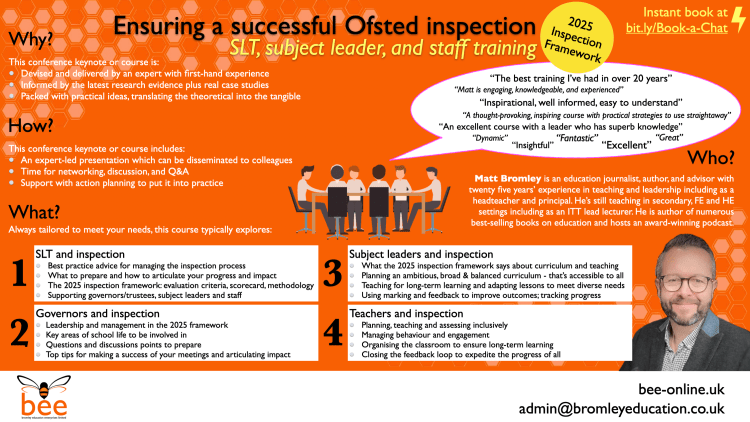
Here’s what colleagues who’ve recently attended Matt’s inspection training have had to say…
“Informative and knowledgeable leader who was both engaging and insightful.”
“Excellent!”
“Very useful – it got us to drill down and reflect on our own practice.”
“Very informative with clear strategic ideas.”
“A very welcome overview of the process.”
“Really informative – it’s made me feel a lot clearer as a new Headteacher of what I need to do to prepare for OFSTED.”
“Very helpful and covered all the main areas.”
“Very thorough and the presenter was engaging.”
“Very informative and thought provoking.”
“Really informative, well-paced, and gave me the information I needed.”
 bee | Bromley Education Enterprises Limited