

What’s on the horizon in 2025/26?
As the summer sun begins to fade and we prepare to open our school gates again, the 2025/26 academic year comes into view – not just as a date in the diary, but as a critical juncture for education.
This coming year, we will have to navigate a shifting policy landscape, as well as evolving societal expectations, and persistent operational pressures.
For governors and trustees, school leaders, and teachers and staff, the key to success is not merely to respond, but to anticipate.
Indeed, strategic vision has never been more crucial. In a climate marked by constant change, those with foresight will be best placed to lead with clarity and conviction.
As such, this series of short blogs aims not just to summarise existing changes but to predict what’s yet to come. It’s a framework for professional curiosity; a panoramic view of the key themes likely to define the year ahead.
In this blog and the one that follows, we will explore…
8 Inspection and accountability
Part Two
Ofsted has finally published its new inspection framework and supporting documents. In the last blog in this series, I explored the 3 principles that will underpin inspection, and gave an overview of the 6 evaluation areas that will now be judged on a 5-point scale. This time I want to offer my advice for preparing for inspection…
There are two calls: the notification call and the planning call.
The notification call
On the notification call, inspectors will ask to speak with the headteacher or, if they are unavailable, the most senior member of school staff who is available. They will inform the school that an inspection is taking place and explain the type and length of the inspection. They will then schedule the planning call and explain that this is normally a video conference, unless technology does not allow this.
I would encourage headteachers to have at least one other senior leader present on the planning call to assist, ideally more. A new role of nominee has been created to support with planning, communication and ongoing engagement throughout the inspection, helping to streamline the workload. This nominee should also be on the call.
Between the notification and planning calls, I would advise headteachers to:
- Notify their chair of governors, academy trust leaders, local authority, and any other relevant stakeholders such as a school improvement advisor or diocese.
- Meet with SLT to gather information for the planning call (see below) and agree who will attend that call – and who will take notes.
- Take a break, get some fresh air, and gather their thoughts.
The planning call
The planning call is in 3 parts:
- Introduction and discussing practicalities
- Understanding the school’s context
- Planning the timetable for the first inspection day
The first part will explore leaders’ well-being, reasonable adjustments and adaptations, and information gathering. Inspectors will want to know about:
- the scheme of delegation
- the school’s religious character
- any nursery provision
- any before- and/or after-school care and holiday clubs managed directly by school
- which decisions are made centrally by trust leaders, and which are delegated to the headteacher
The second part focuses on the school’s context, including any changes since the previous inspection. Specifically, inspectors will want to know about:
- leaders’ recent and ongoing priorities and challenges, the actions they have taken to maintain or improve standards, and how they have assessed the impact of their actions
- leaders’ evaluation of the school’s strengths and successes, and their priorities for improvement, including where they believe they currently sit in terms of the 5-point grading scale for each evaluation area
- any recent tensions in, or pressures from, the community
- any relevant safeguarding matters, as identified by leaders, including any safeguarding concerns, or allegations made about adults
- leaders’ approach to inclusion
- leaders’ approach to ensuring that staff can identify disadvantaged pupils, those with SEND, those known (or previously known) to social care, as well as those who face other barriers to their learning and/or well-being, for example young carers
- the school’s timetable, how the curriculum is organised, and how leaders work with external professionals to meet pupils’ needs
- any current use of part-time timetables and whether the school is currently making any use of alternative provision
And the final part is about scheduling. Inspectors will want to organise meetings with the designated safeguarding lead and those responsible for governance. They will also want a list of pupils for ‘case sampling’. Schools should be ready to:
- select approximately six pupils
- select a representative sample, including:
- a child with EHCP and, where possible, a disabled child
- a looked-after child
- a child known, or previously known, to social care
- a child who receives Pupil Premium funding
- a child from any other group identified as significant to the school’s context
Inspectors will also want to know the following:
- The school’s designated religious character (where applicable)
- The number of pupils on roll (and separately, where applicable, the number of pupils in the post-16 provision), and their sex and age range
- Whether there is any specially resourced provision for pupils with SEND or other pupils, or any other alternative or designated units for pupils
- Whether any pupils attend off-site AP whether any pupils attend a pupil support unit under the school’s URN
- Whether the school has any pupils on roll whose places have been commissioned by a local authority
- Whether any pupils are currently on a part-time timetable, receiving flexi-schooling or being educated remotely
- Whether the school directly leads and manages any nursery provision, before- and/or after-school care or holiday clubs
They’ll want to know:
- Whether the school operates from more than one site, for example whether it offers early years or post-16 provision on separate premises
- What early career framework the school is using for early career teachers (ECTs), if any
- Any reason the inspection should not take place (for example, if the school is within 6 months of confirmed closure and this can be evidenced in a funding agreement)
- Details of (and response to) any recent tensions in, or pressures from, the community
- The start and end date for the next school holiday any other dates when the school will be closed within the next 2 months, for example for a religious festival
- Details (not personal information) of who lives on the school premises
- Information about any other factors the school considers relevant to its current context, including: any concerns, such as perceived conflicts of interest
- Details of the nominee (where applicable)
In addition, inspectors will ask:
- If there are any pupils with SEND: the number of pupils, what their needs are, the type(s) of language and/or communication systems used (for example British Sign Language), and the staffing support they receive
- If any pupils are in off-site AP: information about the AP’s name, address, registration status, URN (if registered), number of pupils that attend and for what reason, their start dates, and the hours they attend
- If any pupils are in any pupil support unit under the school’s URN: information about its purpose, size, location, number of pupils attending, whether it provides for pupils from other schools or pupils whose place is commissioned by a local authority, and the timetables of the pupils attending
- If the school is an academy: information about any pupils who have been transferred to one of the trust’s other academies acting as an AP and who may now be on roll there
- Information about the number of pupils on a part-time timetable, being flexi-schooled or being educated remotely, and any elective home-education arrangements for pupils registered at the school
The following set of strategic documents will be required:
- Anything that sets out school improvement priorities or the longer-term vision
- For maintained schools, minutes from the meetings of the governing body
- For academies, minutes of the board of trustees’ meetings
- Reports from any external evaluation of the school
- Records and analysis about behaviour and attendance,
- Any pupils taken off roll, including the reasons why
- Suspensions and permanent exclusions, incidents of poor behaviour and any use of internal isolation
- Information about the school’s use of AP
- Information about any pupils directed off-site and/or pupils on managed moves
- Any bullying, harassment, or directly or indirectly discriminatory or prejudiced behaviour
- Any sexual harassment and/or sexual violence
- Any restrictive physical intervention
- Inclusion information for case sampling
And they will want the following operational documents:
- Wi-Fi details, if the school has it, so that inspectors can connect to the internet
- Map of the school buildings and other practical information
- The school timetable
- The current staff list (indicating ECTs, mentors and induction tutors)
- Details of any staff absence
- Times for the school day, including any planned interruptions to normal school routines
Throughout these calls and the early stages of a visit, I would advise that SLT remember that inspectors do not know your school the way you do. You walk those corridors day in day out, greet pupils and their families every morning, and know your staff. As such, do not be afraid to correct inspectors’ misconceptions or mistakes, and to – robustly but diplomatically – disagree with inspectors’ perceptions and judgments. Just make sure you have supporting evidence!
Remember, too, that the planning call isn’t a test. The inspector will be looking to triangulate everything you tell them with staff and pupils when they visit your school. So, be as honest and as clear as you can. If you don’t know an answer, say so, and promise to find out. And be realistic: don’t massage data or stretch the truth; if something isn’t yet good enough, say so and explain what you’re doing about it.
While being a headteacher or senior leader can feel lonely at times, remember you are far from alone and your staff are going to be pivotal as you go navigate the inspection process. So, keep them in the loop and keep them positive. Walk the floor, smile, check in, reassure.
After the planning call, I’d suggest you:
- Call your chair of governors to provide an update and ask them to share information with the governing body when organising those who will meet the inspector.
- Notify all staff quickly, via email if necessary, about the inspection.
- Meet with staff in person at the end of the school day to answer any questions and provide reassurance.
- Discuss with senior colleagues any timetable arrangements and amendments necessary to the usual running of the school day.
- Arrange to meet with the middle leaders who are likely to be involved in learning walks and meetings.
- Arrange food for any staff members staying late to finish preparations – but try to avoid this! Better to encourage everyone to go home and switch off!
- Send survey links to parents/carers.
- Check the school environment before you leave. Is everything where it should be?
More than anything, instead of thinking ‘oh no, here we go’ when that call comes, try thinking ‘let’s go, we’re ready to show off our wonderful school’.
Top 5 tips
Here are my top 5 tips for preparing for inspection…
- Remember Ofsted are not why we do what we do! Operate your normal school day and don’t panic! Preparation is not about rehearsing a performance; it’s about making your day-to-day reality inspection ready.
- Make quality assurance your routine, not your rescue plan. Maintain a rolling SEF that is updated termly with fresh evidence; avoid the “midnight before” rewrite. Link quantitative data, qualitative feedback (pupil/staff voice), and first-hand observation to tell a coherent story. Ensure every subject lead has a concise curriculum narrative, key data trends and how they’ve been addressed, and examples of pupil work showing progression over time
- Align your narrative to impact, not activity. Ofsted will be less interested in what you are doing, and more in what difference it makes. When discussing interventions, talk about impact on pupil learning rather than simply listing strategies. For wellbeing initiatives, show how they improve attendance, engagement, or retention. In SEND provision, evidence closing gaps over time, not just provision offered.
- Embed cultural readiness. Inspection readiness is as much about mindset as it is about paperwork. Think: can all staff articulate the school’s vision and core pedagogical principles in plain language? Can all staff explain their role in safeguarding, curriculum delivery, and pupil wellbeing? Can all pupils describe their learning, how they know they are making progress, and how the school supports them?
- Keep safeguarding inspection ready. Conduct termly safeguarding audits against the latest KCSIE and anticipated 2025 safeguarding guidance. Train all staff on emerging priorities (AI safety, gender-questioning student protocols, online harms). Ensure case records are accurate, timely, and securely stored – inspectors often look for consistency here as an indicator of culture.
And above all… protect staff wellbeing during before, during, and after an inspection. Avoid “mock inspections” that mimic stress without improving practice – opt for coaching-based reviews instead. Keep paperwork requirements proportionate; don’t generate “for Ofsted” documents that have no day-to-day value. Reassure staff that preparation is about showcasing reality, not performing perfection.

If inspection readiness is baked into your everyday systems, there’s no need to gear up when the call comes because the call won’t change what you do. The most confident schools are those where: Quality assurance is live, lean, and purposeful; everyone can tell the school’s story; and impact is clear, consistent, and compelling.
Talking of which…
Articulating impact
Here’s a useful rubric I’ve developed to help articulate to inspectors the impact of your actions since the last inspection. It will keep you focused and succinct.
Objective: In order to… [eg improve the attendance of disadvantaged pupils]
Actions: We did x, y, x… [detail the tangible steps taken: what, when, by whom]
Impact: As a result of which, we… [use comparative data which shows the improvement not the outcome, eg the attendance of disadvantaged pupils improved from X% to Y% / by X percentage points]
Evidence: We know this because… [outline the data sources, aim for a weight of evidence which combines quantitative and qualitative data inc staff/pupil voice]
Next: Our next step is… [say what you’ll do now to further improve/sustain/embed your good practice]
It would be helpful to have a line prepared for each of your areas for improvement from the last inspection. In addition, I’d suggest you have a slimmed down version of your school improvement plan in which you articulate your top 3 strengths as a school and your top 2 areas for development. Share this with staff so everyone says the same things. For each aspect, explain:
- The strength
- How we know it’s a strength
- How we’re maintaining / embedding this good practice
- The weakness
- How we know it’s a weakness
- What we’ve already done to address it
- What more we plan to do
- Our intended outcome
Busting some myths
To conclude, here’s a useful reminder of what not to do!
Schools do not need to provide:
- any information beyond what Ofsted specifically ask for
- information in any specific format (as long as it is easily accessible for inspectors)
- written evidence of oral feedback to pupils
- predictions of attainment and progress scores
- performance and pupil-tracking information
- any specific document or plan in relation to the Pupil Premium
In terms of curriculum, Ofsted say they evaluate schools that take radically different approaches to the curriculum fairly and evaluate a school’s curriculum favourably if they have built or adopted a curriculum with appropriate coverage, content, structure and sequencing, and implemented it effectively.
Inspectors will consider the extent to which the curriculum reflects the breadth and ambition of the national curriculum, and how inclusive the curriculum, culture and practices are. This is the case whether the school has devised its own curriculum or uses, for example, commercial or local schemes. It is up to school leaders to determine the school’s practices and to justify these on their own merits.
Likewise, Ofsted do not prefer any particular method of planning (including lesson or curriculum planning), teaching or assessment. They do not expect a specific format for curriculum planning. They do not require schools to show individual lesson plans or previous lesson plans.
As before, Ofsted do not grade individual teachers or lessons, and they do not evaluate individual pupil workbooks or expect workbooks to be compiled solely to provide evidence for inspection. They do not use work scrutiny to evaluate teachers’ marking.
Talking of marking, as before, Ofsted do not specify the frequency, type or volume of marking and feedback. They do not require schools to make sure that work in pupils’ books or folders is of a specific quantity or done at a particular frequency.
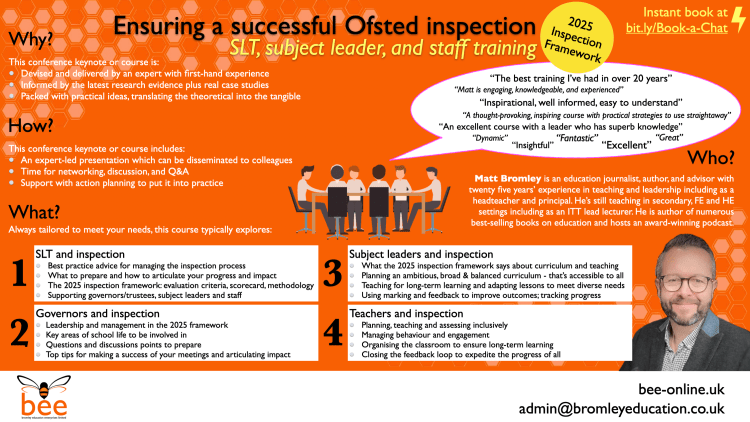
Want help preparing for inspection?
We also offer a Critical Friend school improvement service


 bee | Bromley Education Enterprises Limited