
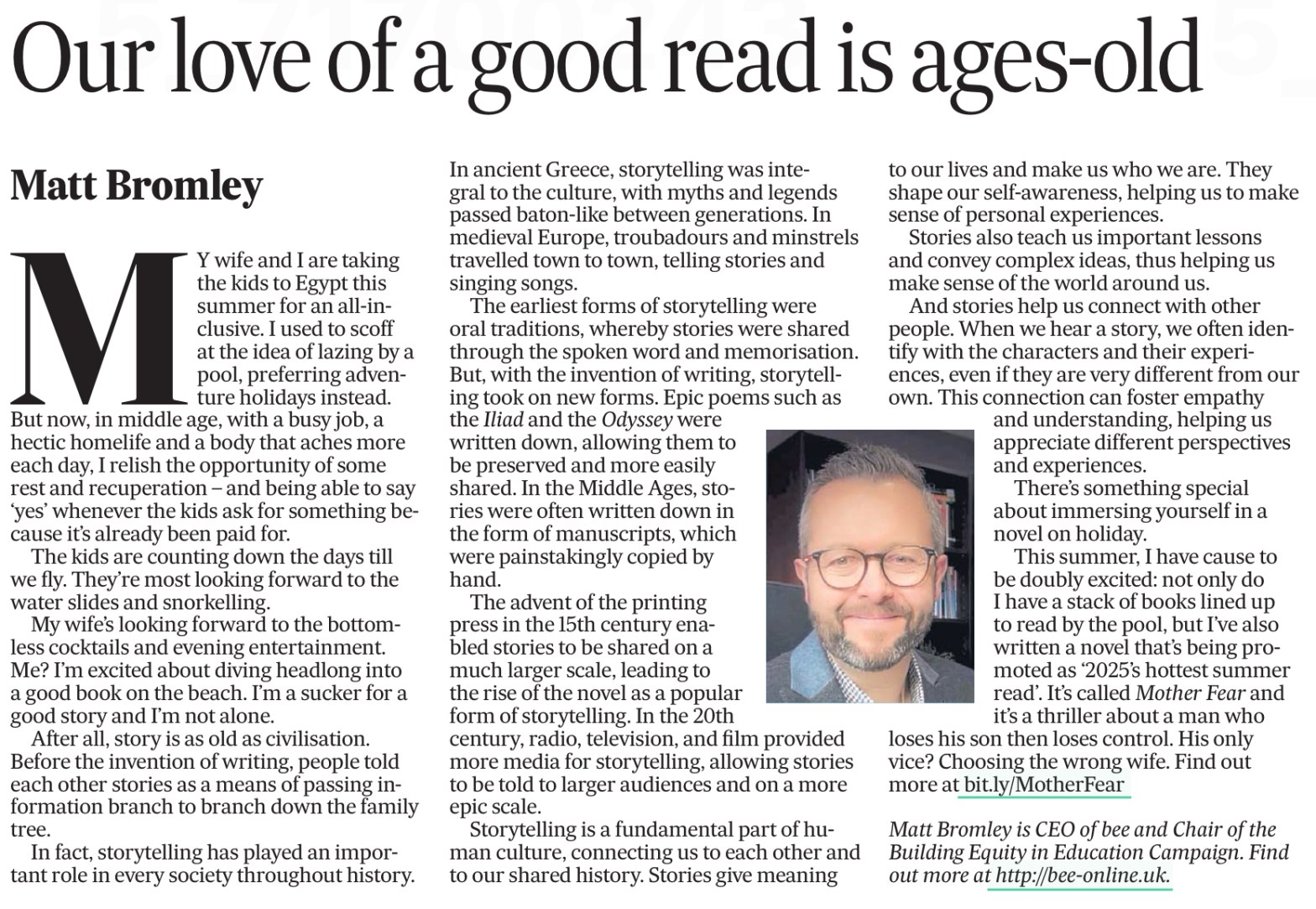
This is an edited version of an article that appeared in The Yorkshire Post on 2 August 2025 in which Matt Bromley analyses the features of a good beach read…
My wife and I are taking the kids to Egypt this summer for an all-inclusive. I used to scoff at the idea of lazing by a pool, preferring adventure holidays instead. But now, in middle age, with a busy job, a hectic homelife, and a body that aches more each day, I relish the opportunity of some rest and recuperation – and being able to say ‘yes’ whenever the kids ask for something because it’s already been paid for!
The kids are counting down the days till we fly. They’re most looking forward to the water slides and snorkelling. My wife’s looking forward to the bottomless cocktails and evening entertainment. Me? I’m excited about diving headlong into a good book on the beach! I’m a sucker for a good story and I’m not alone.
After all, story is as old as civilisation. Before the invention of writing, people told each other stories as a means of passing information branch to branch down the family tree. In fact, storytelling has played an important role in every society throughout history. In ancient Greece, storytelling was integral to the culture, with myths and legends passed baton-like between generations. In medieval Europe, troubadours and minstrels travelled town to town, telling stories and singing songs.
The earliest forms of storytelling were oral traditions, whereby stories were shared through the spoken word and memorisation. But, with the invention of writing, storytelling took on new forms. Epic poems such as the Iliad and the Odyssey were written down, allowing them to be preserved and more easily shared. In the Middle Ages, stories were often written down in the form of manuscripts, which were painstakingly copied by hand.
The advent of the printing press in the 15th Century enabled stories to be shared on a much larger scale, leading to the rise of the novel as a popular form of storytelling. In the 20th Century, radio, television, and film provided more media for storytelling, allowing stories to be told to larger audiences and on a more epic scale.
Storytelling is a fundamental part of human culture, connecting us to each other and to our shared history. Stories give meaning to our lives and make us who we are. They shape our self-awareness, helping us to make sense of personal experiences.
Stories also teach us important lessons and convey complex ideas, thus helping us make sense of the world around us.
And stories help us connect with other people. When we hear a story, we often identify with the characters and their experiences, even if they are very different to our own. This connection can foster empathy and understanding, helping us appreciate different perspectives and experiences.
There’s something special about immersing yourself in a novel on holiday – it’s why articles recommending the best books to pack in your case are ubiquitous – and why the term ‘beach read’ has entered then lexicon.
This summer, I have cause to be doubly excited: not only do I have a stack of books lined up to read by the pool, but I’ve also written a novel that’s being promoted as ‘2025’s hottest summer read’. It’s called Mother Fear and it’s a thriller about a man who loses his son then loses control. His only vice? Choosing the wrong wife. Find out more at bit.ly/MotherFear
When I saw the tagline, I did wonder what qualified a book as the perfect summer read. Books are sometimes referred to as ‘airport novels’ but that tends to be a derogatory term implying they’re cliched or formulaic. But ‘beach reads’ are different.
Firstly, they’re easy to get into. They hook you quickly, ideally within the first few pages. There is no complex world-building or dense prose — the narrative flows even with the distraction of screaming kids.
Secondly, they’re engaging but not too heavy. They have a compelling plot and may be emotional, but they’re not too cerebral. They don’t feel like homework.
Thirdly, beach reads offer escapism. Their stories transport you to a different time and place. You’re on the beach to escape real life — a beach read matches the mood.
So, what will you be reading this summer?

 bee | Bromley Education Enterprises Limited