
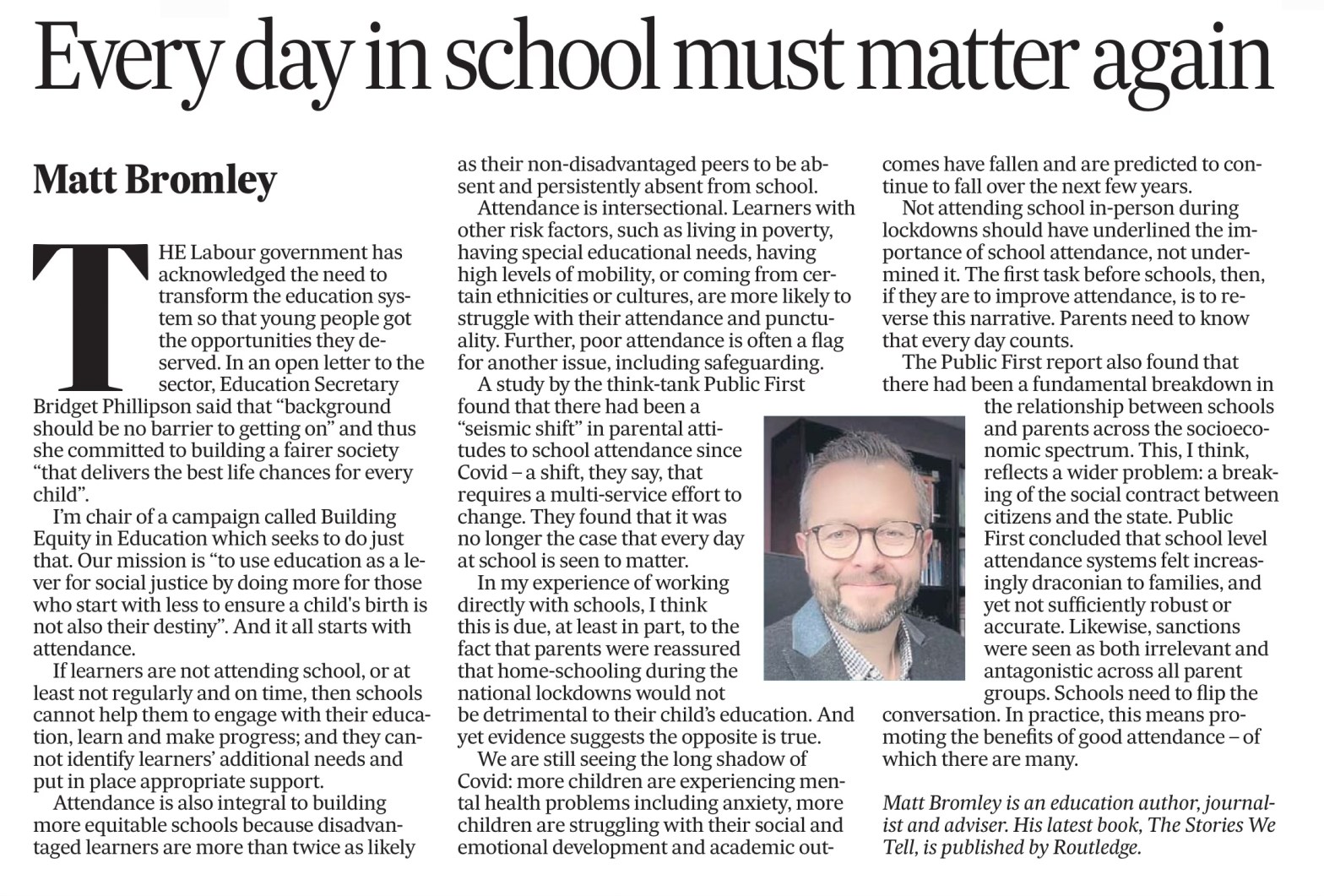
This is an edited version of an article that appeared in The Yorkshire Post on 18 September 2024 in which Matt Bromley argues every day in school must count…
The Labour government elected on 4 July acknowledged the need to transform the education system so that young people got the opportunities they deserved. In an open letter to the sector, Education Secretary Bridget Phillipson said that “background should be no barrier to getting on” and thus she committed to building a fairer society “that delivers the best life chances for every child”.
I’m chair of a campaign called Building Equity in Education which seeks to do just that. Our mission is “to use education as a lever for social justice by doing more for those who start with less to ensure a child’s birth is not also their destiny”.
And it all starts with attendance.
If learners are not attending school, or at least not regularly and on time, then schools cannot help them to engage with their education, learn and make progress; and they cannot identify learners’ additional needs and put in place appropriate support.
Attendance is also integral to building more equitable schools because disadvantaged learners are more than twice as likely as their non-disadvantaged peers to be absent and persistently absent from school.
Attendance is intersectional. Learners with other risk factors, such as living in poverty, having special educational needs, having high levels of mobility, or coming from certain ethnicities or cultures, are more likely to struggle with their attendance and punctuality. Further, poor attendance is often a flag for another issue, including safeguarding.
A study by the thinktank Public First[1] found that there had been a “seismic shift” in parental attitudes to school attendance since Covid – a shift, they say, that requires a monumental multi-service effort to change. They found that it was no longer the case that every day at school is seen to matter.
In my experience of working directly with schools, I think this is due, at least in part, to the fact that parents were reassured that home-schooling during the national lockdowns would not be detrimental to their child’s education. And yet evidence suggests the opposite is true. We are still seeing the long shadow of Covid: more children are experiencing mental health problems including anxiety[2], more children are struggling with their social and emotional development[3], and academic outcomes have fallen and are predicted to continue to fall over the next few years[4]. Not attending school in-person during lockdowns should have underlined the importance of school attendance, not undermined it. The first task before schools, then, if they are to improve attendance, is to reverse this narrative. Parents need to know that every day counts.
The Public First report also found that there had been a fundamental breakdown in the relationship between schools and parents across the socioeconomic spectrum. This, I think, reflects a wider problem: a breaking of the social contract between citizens and the state. Indeed, Amanda Spielman, in her final annual report as head of Ofsted, said that “in education we have seen a troubling shift in attitudes since the pandemic. The social contract that has long bound parents and schools together has been damaged.”[5]
Public First concluded that school level attendance systems felt increasingly draconian to families, and yet not sufficiently robust or accurate. Likewise, sanctions were seen as both irrelevant and antagonistic across all parent groups.
Certainly, I think there is little value in sharing headline statistics with parents. Attendance statistics are often meaningless and certainly do not have the traction schools might think. Further, many parents regard school communications on attendance to be too generic and often negative.
Indeed, in my experience, schools do tend to adopt a deficit model, talking of absences and lateness, rather than attendance and punctuality, and focusing on the detrimental impact of missing school, rather than selling the positive benefits of good attendance. Schools need to flip the conversation.
In practice, this means promoting the benefits of good attendance – of which there are many, including:
- Better progress
- Improved outcomes
- Progression to FE/HE
- Better job prospects
- Higher earnings
- Improved health and wellbeing
In tackling the ‘attendance gap’, I’d also suggest schools take a 3-pronged approach which starts by exploring in-school factors – the push and pull of school life.
[1] Burtonshaw, S & Dorrell, E, (2023) Listening to, and learning from, parents in the attendance crisis. Public First https://www.publicfirst.co.uk/wp-content/uploads/2023/09/ATTENDANCE-REPORT-V02.pdf
[2] https://www.ox.ac.uk/news/2023-09-21-young-people-s-mental-health-deteriorated-greater-rate-during-pandemic-major-new
[3] https://educationendowmentfoundation.org.uk/news/new-pandemic-adversely-affected-young-childrens-development-with-fewer-reaching-expected-levels-by-the-end-of-reception-class
[4] https://www.theguardian.com/education/2024/apr/24/pupils-in-england-facing-worst-exam-results-in-decades-after-covid-closures-says-study
[5] https://www.gov.uk/government/publications/ofsted-annual-report-202223-education-childrens-services-and-skills/the-annual-report-of-his-majestys-chief-inspector-of-education-childrens-services-and-skills-202223#hmci-commentary
About the author
Matt Bromley is CEO of bee. He is an education journalist, author, and advisor with twenty five years’ experience in teaching and leadership including as a secondary school headteacher and academy principal, further education college vice principal, and multi-academy trust director.
Matt is a public speaker, trainer, initial teacher training lecturer, and school improvement advisor. He remains a practising teacher, currently working in secondary, FE and HE settings.
Matt writes for various magazines, is the author of numerous best-selling books on education, and co-hosts an award-winning podcast.
Find out more here. Follow Matt on X @mj_bromley
 bee | Bromley Education Enterprises Limited