
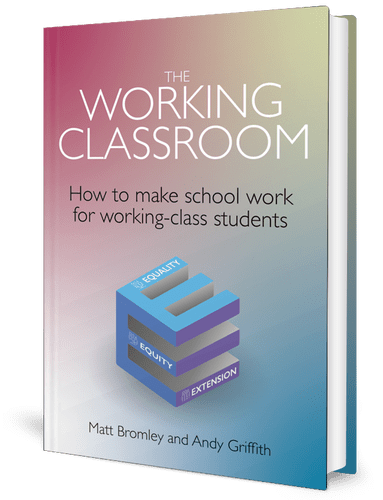
This is a version of an article by Matt Bromley which has appeared in various publications including Headteacher Update, SecEd, and DiverseEd, written to accompany the book, The Working Classroom.
This is part two of a 2-part series. Catch up with part one.
Last time, I argued that social class should be the 10th protected characteristic. Why? Because there are currently three problems with classism with regards curriculum delivery.
Problem 1: Curriculum design
The stated aim of the national curriculum is to ensure that all students in England encounter the same content and material. The curriculum should provide students with ‘an introduction to the essential knowledge that they need to be educated citizens’. There are two problems with this.
- Curriculum coverage – one size doesn’t fit all. Providing all students with the same curriculum further disadvantages those who are already disadvantaged. We must deliver the same ambitious curriculum to every pupil, irrespective of their background. But we should offer more, not less – but, crucially, not the same – to working-class students. We must broaden the curriculum for working-class students to ensure equity as opposed to equality. According to the Equality and Human Rights Commission, equality is about ‘ensuring that every individual has an equal opportunity to make the most of their lives and talents’, whereas equity is about giving more to those who need it. Therefore, we need to provide the same ambitious curriculum to all, and then complement it with additional opportunities for those whose starting points are lower or for whom opportunities are more limited. The aim of equity in education should not be social mobility. Social mobility implies lifting students out of the working classes and leaving behind all that they are and identify with. Rather, the aim of equity in education is to celebrate and embrace students’ working-class roots, while simultaneously ensuring those roots don’t take a stranglehold of their life chances. We want to widen horizons and remove barriers to success; we don’t want the sun to set on working-class students’ rich and proud ancestry. As such, the aim of equity in education is social justice.
- Curriculum content – definitions of core knowledge are classist. In other words, definitions are based on the notion that wealth and social status confer taste and discernment, and the selection of knowledge is made by those of a higher social standing rather than by a representative group of people from across the social strata. Since 2019, Ofsted have inspected the way that schools develop students’ cultural capital. Controversially, perhaps, they describe cultural capital as ‘the best that has been thought and said’, but who decides what constitutes the ‘best’? Notions of best are, by definition, subjective value choices. Sadly, all too often, these choices are made by politicians from middle-class backgrounds. Every school’s curriculum should celebrate working-class culture alongside culture from the dominant classes. Working-class students tend to be denied the experiences their middle-class peers are afforded, such as reading books at home, visiting museums and art galleries, taking part in educational trips, enjoying foreign holidays and so on.
Problem 2: Curriculum assessment
Our current assessment system could also be regarded as classist. There are three elements to consider here:
- The home advantage. Those who don’t have a home life that is conducive to independent study are placed at a disadvantage, which is compounded for those who don’t have parents with the capacity to support them – whether in terms of time, ability or money (e.g. buying learning resources such as a computer, books, pens and paper).
- The content of exams, which tend to have a middle-class bias, such as requiring students to have personal experience of foreign travel and theatre visits.
- The outcome of exams. The assessment system is designed to fail a third of students every year – and it is the working classes who the suffer most. ASCL argues that the fact that this represents around a third of 16-year-olds every year ‘is not an accident but the product of the system of comparable outcomes whereby the spread of GCSE grades is pegged to what cohorts of similar ability achieved in the past. Young people who fall below this bar pay a high price in terms of reduced prospects in progression to further and higher education and to careers.’
Problem 3: The hidden curriculum
All schools have a hidden curriculum. It exists in a school’s rules and routines; in its behaviour policies, rewards and sanctions systems; in its physical environment, social environment and learning environment; and in the way all the adults who work in the school interact with each other and with the students. Students in private schools have an extra hidden curriculum – albeit hidden in plain sight. Private school students are taught that they are part of the elite and their place in society is to rule over others. It is their destiny and their birthright because that is the way we do things in this country. And it works.
Working-class students in state schools might be told that we live in a meritocracy – that with hard work and the right mindset anyone can achieve anything. But they soon realise that merit is all smoke and mirrors. It is harder to have a growth mindset if you live in a cold, damp and overcrowded rented flat. It is harder to attend an after-school drama club if you are expected to collect a younger sibling from primary school. And it is harder to do well in exams if you have nowhere to study and no access to the internet or a computer.
Making class a protected characteristic
If social class were to be considered, under the Equality Act 2010, the 10th protected characteristic, then schools would be required by law to:
- remove or minimise disadvantages suffered by working-class pupils
- take steps to meet the particular needs of working-class pupils
- encourage working-class pupils to participate fully in a full range of school societies
To show that due regard is being had to the importance of advancing equality of opportunity for working-class pupils, schools would also need to include information about the steps they have taken in response to their analysis of the available data.
One way in which schools commit is through the publication of equality objectives. Schools are free to choose the equality objectives that best suit their individual circumstances and contribute to the welfare of their pupils and the school community. And objectives are not intended to be burdensome or a ‘tick box’ exercise. But they do need to be specific and measurable, and they should be used as a tool to help improve the school experience of a range of different pupils – in this case, working-class pupils.
We can see how a set of equality objectives pertaining to social class would be framed and how they’d help raise the issue of classism in education and set all schools on a path to equity.
So, let us all commit to:
- to increase participation by working class pupils in after school activities;
- to narrow the gap in performance of working class pupils;
- to reduce exclusion rates for working class pupils;
- to increase understanding between different socio-economic groups;
- to reduce the number of classist incidents;
- to raise the attainment of working class pupils;
- to encourage working class pupils to consider career options traditionally the preserve of their middle class peers;
- to anticipate the needs of incoming working-class pupils, including gaps in their lived experience and cultural capital.
The good news is we don’t have to wait for the Equality Act to catch up – we can start doing all this now. And, in so doing, we can commit to making the classroom work for working-class pupils.
Find out more about supporting working-class pupils in The Working Classroom by Matt Bromley and Andy Griffith, published by Crown House. Visit www.theworkingclassroom.co.uk for information and to access free resources.
Follow Matt on X @mj_bromley for more teaching tips like these.
 bee | Bromley Education Enterprises Limited