

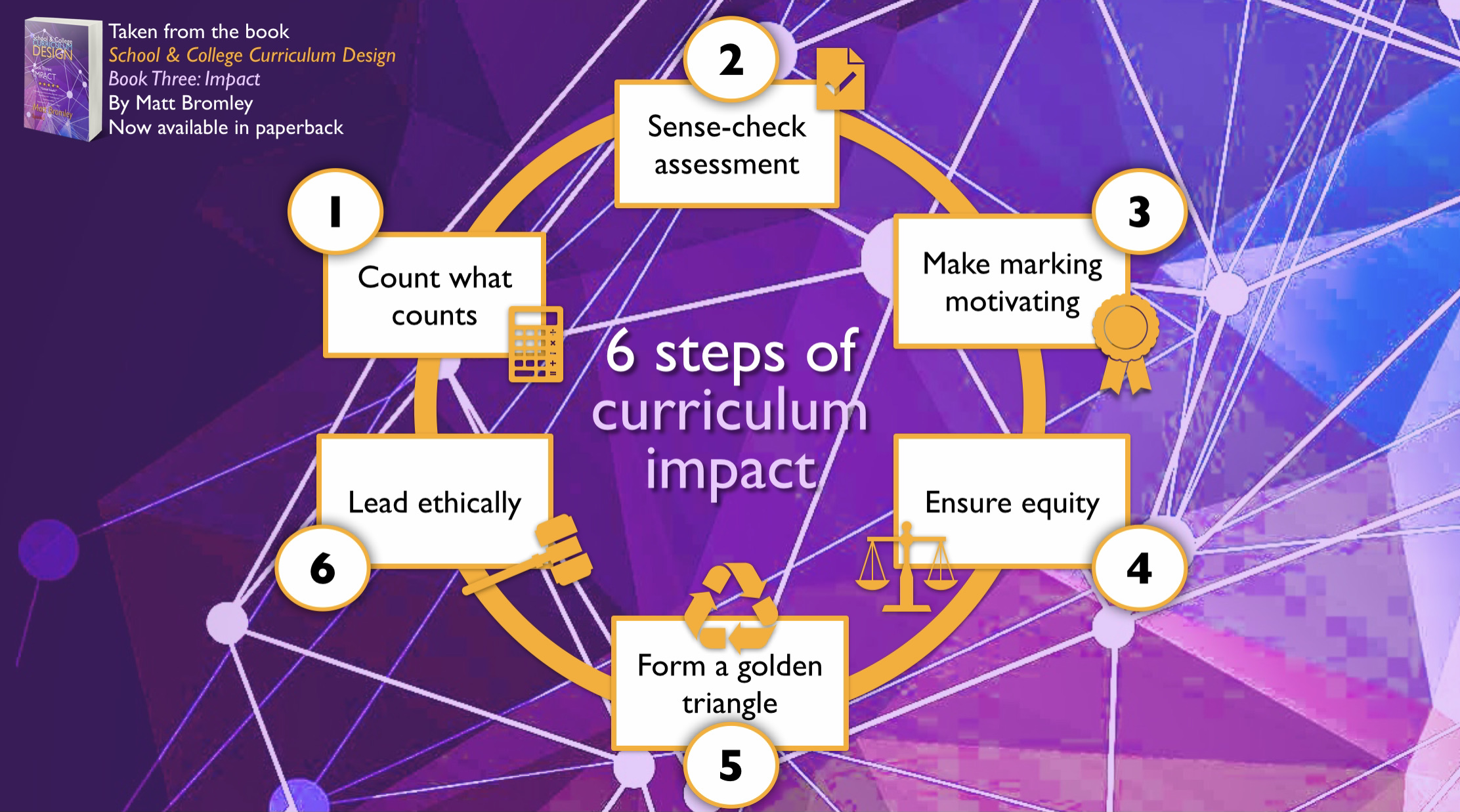

This is an edited extract from the book, School and College Curriculum Design 3: Impact. For more information on this book and the first two in the series, as well as to access a raft of free curriculum resources, visit our Curriculum Central page.
Ethical leadership principles
Ethical leadership in education is driven by a respect for values and an unfaltering belief in the dignity and rights of others. Ethical leaders build school cultures governed by fair, clearly articulated expectations, rather than cultures driven by personalities or politics.
In an ethically led school, there is a clear vision and mission, and a set of shared values and principles, that are understood and owned by everyone who works there.
Every action that is taken is sense-checked against this vision and mission – if completion of said action would not aid the pursuit of the vision and mission, it isn’t deemed important; as well as against these values and principles – if completion of said action would not uphold the values and principles, it isn’t considered valid.
Every element of the school, from performance management appraisals to staff professional development, from expectations of pupil behaviour to the resourcing of the curriculum, reflects this vision and mission, and these values and principles.
Ethical leaders cannot pick and choose which situations call for moral judgment or leave their principles at the door whenever it’s convenient; an ethical code provides the very foundations on which these schools are built and function day-to-day.
In practice, ethical leadership is, I think, anchored in five principles:
1. Honesty
2. Justice
3. Respect
4. Community
5. Integrity
Above all else, I think, ethical leaders are kind leaders…
Ethical school leaders routinely recognise and reward success. For ethical leaders, celebrating others’ achievements is an everyday part of what they do rather than an afterthought or rarity. Ethical leaders also give quality time to people, have an open-door policy – which does not mean being available twenty-four hours a day, but rather being able to meet with staff as soon as possible and listening and responding to what they have to say. Ethical leaders are protective of their staff, showing empathy, respecting people’s privacy, remembering birthdays, and granting personal leave – without question – when staff have important or urgent personal matters to attend to such as family funerals. They also set as their default position a genuine belief that everybody wishes to do well and will try their best, rather than assuming the worst of people.
Parental engagement
Let’s consider a few starting principles…
Firstly, parental communication needs to start early and continue throughout a pupil’s journey through school. The parents of pupils moving from nursery to primary school, or from primary to secondary, will not want to receive information halfway through the summer holiday at which point it will be deemed too late. Schools need to engage with parents early and clearly set out their expectations and requirements.
Secondly, parental communication needs to be a two-way process: as well as the school staying in touch with parents, parents also need a means of keeping in contact with the school. One way to do this is to create a frequently asked questions (FAQ) page, as well as a Q&A facility and a parents’ forum on the school’s website. This will need to be monitored carefully, of course, or perhaps pass through a ‘gatekeeper’ in order to be vetted before comments are made ‘live’. In order for it to be viewed as worthwhile, the school will also need to communicate its response to parental comments and suggestions, perhaps through a ‘You Said, We Did’ page.
Thirdly, parental communications need to be appropriately timed, relevant and useful and one way to do this is to utilise the experience and expertise of pupils and their parents. For example, the parents of current Reception or Year 7 pupils will be able to share their thoughts on what information they needed when they went through the transition process with their child not so long ago, as well as when they needed it most, whilst current Reception or Year 7 pupils will be able to offer their advice about how to prepare for primary or secondary school by, to give but two examples, providing a reading list for the summer and sharing their advice on how to get ready for the first day of school.
Fourthly, parental communication should take many forms and embrace new and emerging technologies. The use of technologies such as email, texting, websites, electronic portfolios and online assessment and reporting tools can make communication between parents and teachers more timely, efficient, productive and satisfying.
Of course, doing all of this effectively takes time and yet it is important to balance the needs of parents with those of hard-working teachers. You do not want the unintended consequence of effective parental engagement to be an unworkable teacher workload.
Crisis management
The Covid-19 pandemic has provided school and college leaders with a crash-course in crisis management. Although I’m sure we all hope we don’t have to use these new-found skills any time soon, I think it is worth unpacking what we’ve learned because crises, though certainly not commonplace, do inevitably plague us from time to time.
During my tenure as a senior school and college leader and as a headteacher, I had several crises to deal with including the murder of one pupil by another, the sudden death of a much-loved colleague, fires and floods, bomb threats, and of course ‘snow-day’ closures. None of these crises compares with the scale of the Covid pandemic, of course, and I have nothing but admiration and respect for every colleague who’s worked hard to keep their schools calm and orderly and to protect their pupils over the last year or so.
So, what can school and college leaders do to help prepare for the unexpected and to manage a crisis as it unfolds?
Many organisations use a prevention, preparation, response, recovery model (PPPR) of crisis management which describes three levels of intervention:
1. Primary intervention, which consists of activities devoted to preventing a crisis from occurring (this would equate to prevention in the PPPR model)
2. Secondary intervention or the steps taken in the immediate aftermath of a crisis to minimise the effects and keep the crisis from escalating (this would equate to response)
3. Tertiary intervention, which involves providing long-term follow-up assistance to those who have experienced a severe crisis (this would equate to recovery)
There are two key actions I would recommend taking by way of preparation for an emergency:
1. Write a crisis management plan
2. Put together a crisis management team
And here are some tips for mitigating some of the worst effects of a crisis and to help others cope with an emergency as it unfolds…
Be empathetic – Appreciate that, during a crisis, staff, pupils and parents/carers will be under immense stress and as such may not always act as professionally or courteously as you’d like or expect them to do, and they may occasionally take their frustrations out on you. It is not personal; you must not take it to heart. You are a figurehead, a community leader, and it is what you represent, not who you are, that sometimes makes you a target for their vitriol.
Be patient and forgiving – You also need to be understanding if some parents/carers don’t want to follow the party line. Some parents will disagree with you whatever decision you take during a crisis, and some will feel the need to vent their anger publicly. Others will simply ignore your advice or direction and undermine you.
Be visible – It’s tempting at times of heightened stress to descend to your bunker. And you’ll certainly need time to think through and make important decisions, as well as to craft regular communications to all your stakeholders. But people really need your leadership during a crisis and that means you need to lead from the front. So be visible, be available, and be kind. If it’s possible, get out and walk the floor.
Keep communicating – People will need to know what’s happening and they will need to feel informed and involved. Regular, measured communications are therefore vital during this crisis. You should try to sound human in your written communications so don’t just copy and paste the official line; rather, put it into friendly language that reflects your local context and sounds like you.
Now visit our Curriculum Central page for more curriculum resources including a preview of Book Three.

 bee | Bromley Education Enterprises Limited